
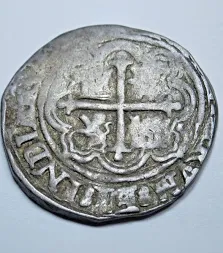
Spanish Dollatr 1500’s
The Hakka, Borneo and the Spanish Dollar.
China had goods the Western world wanted, such as porcelain, cloth, iron tools, beads and other products. They accepted silver for the payment of these goods.
The Spanish had established colonies in Bolivia and Peru. They opened silver mines, and the silver was minted into coins, called cobs, at several small mints and especially at the Potosi mint in Bolivia. The coins were later called Spanish dollars in the 1770’s. They were often cut into eight separate pieces to make change. These became known as pieces of eight.
The coins were shipped to the port of Acapulco, where a Spanish merchant and his investors had previously sent Chinese goods. His agent in Acapulco sold the goods. He received payment in Spanish silver coins. His agent put the coins on a ship in Acapulco, and the ship sailed to Manila. The Spanish merchant received his payment. These coins were then dispersed to the Chinese middlemen, kept as a profit or used to purchase land from the Crown of Spain. This was called the Galleon trade.
The goods sold in Acapulco were then sold to merchants in Mexico City and elsewhere in New Spain, where there was a major market for Chinese goods, especially silk. Some of the goods were shipped to Vera Cruz and then across the Atlantic to Europe.
Chinese merchants borrowed money at high interest rates, leaving their wives and children with the lender as security. A wealthy merchant rented the junk, who in turn rented space below deck at a rate of 20% of gross sales. The merchants slept on top of their cargo on the 650-mile voyage to Manila. When the junks arrived in Manila, the Chinese middlemen awaited them. The Chinese middlemen purchased the goods from the junks and their dealers. They, in turn, sold the goods to the Spanish merchants.
The Chinese, especially the Hokkien, brought goods to Manila. The Spanish merchants purchased those goods in exchange for the silver coins. The cycle: Chinese goods to Spanish merchant in Manila to Spanish galleon to Acapulco, sold the goods in Acapulco for Spanish coins and then Spanish coins came back to Manila to the merchant on the return voyage, continued from 1571-1815.
The Chinese, who now had the Spanish coins, sailed back to China and Southeast Asia and purchased more goods and returned to Manila. Because the coin was 90% silver, the Chinese would use the Spanish coin as a medium of exchange throughout Southeast Asia and beyond.
In relation to this, gold was 60% cheaper in China than in Europe, and the Chinese eagerly exchanged the silver coins for gold. Under the Ming dynasty, taxes had to be paid in silver instead of grain or paper money, which provided a huge demand for silver. Silver provided a stable medium of exchange, unlike gold, which was considered too scarce. Gold was rarer in China and often hoarded for jewellery, prestige, or temple offerings. Silver, by contrast, was more available through trade and suited for large-scale circulation. China’s huge population and complex economy needed a reliable medium for everyday transactions. Silver coins and ingots were practical for commerce, while gold was too valuable for small-scale trade.
In Southeast Asia, these coins then circulated in ports of call such as Brunei, Batavia (Jakarta) and Malacca. They became the backbone of the pepper trade, being traded for the spice. They were used in trade for gold in Sambas and diamonds in Bajarmassin. They were trusted because of the purity of silver, having been minted in South America.
The lives of the Hakka in China during the 1500s were marginal. There was conflict for fertile land, and the Hakka, often considered outsiders by others, lived in fortified villages. Manila was viewed as a paradise with mountains of gold and silver to be had for all. Thousands were eager to leave and avail themselves of such richness.
The junks not only carried merchandise but also Hakka immigrants. A large number of these Hakka remained in Manila and lived in a section of town called Parian and were called Sangleys. By 1638, over 20,000 Sangley lived in Parian. Landed Spanish landowners would hire the Hakka to work their land, and they became vegetable growers, craftsmen, shopkeepers and artisans for Manila and surrounding areas.
There were two major massacres of the Hakka. In 1603, 25,000 Sangleys were slaughtered by the Spanish, the Japanese who maintained a colony there and local Philippine thugs. However, between 1603 and 1640, immigrants kept coming to Manila aboard junks and repopulated the area. A second massacre occurred in 1640, costing another 20,000 Hakka lives. When the peace came, junks which had brought merchandise returned to China with thousands of returning Hakka returning back to China.
Following the 1640 massacre, those Hakka who remained in Manila began a dispersal throughout Southeast Asia. Many resettled in the trading hubs of Malacca, Ayutthaya (Thailand), Longvek and Phnom Penh (Cambodia) and Hoi An, Tonkin, and Ha Tien in Viet Nam. The Manila Hakka did not seem to migrate into Borneo or other parts of Indonesia.
In 1740, the Panembahan of Mempawah or perhaps the Sultan of Sambas had decided to import Chinese labourers to mine gold. This introduced another wave of Hakkas from China, from where most of the Hakkas in Borneo are descended.
The Spanish dollar became widely used in trade throughout Southeast Asia from 1575 onwards. On Borneo, trade at first was the barter method where Chinese goods were traded for Borneo products. Later, a combination of Dutch Guilders, and Spanish dollars was used. Prior to 1863, James Brooke paid his staff and military expenses in Spanish dollars. The Sarawak dollar came into being in 1858 and was used as a local medium of exchange. The Spanish dollar continued to be used for large construction projects and international exchange.
Tom McLaughlin for BorneoHistory.net
Select references:
Giraldez, Arturo The Age of Trade: The Manila Galleons and the Dawn of the Global Economy Lahham, Maryland: Rowman and Little Field 2015
Heidhues, Mary Golddiggers, Farmers and Traders in the “Chinese Districts” of West Kalimatan Indonesia Ithaca: Cornell Southeast Asia Programs, 2003
Li, Tana Cochinchinese Coin Casting and Circulating in Eighteenth-Century Southeast Asia” In Chinese Circulations: Capital, Commodities, and Networks in Southeast Asia, edited by Eric Tagliacozzo and Wen-Chin Chang, Durham, NC: Duke University Press, 2011.