
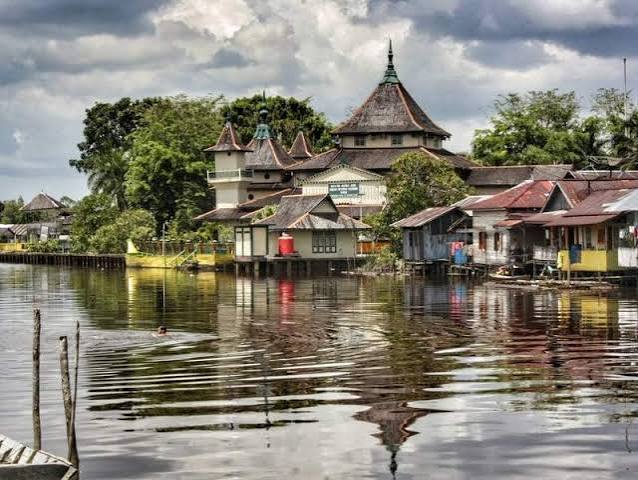
Sambas and Sarawak
The origins of the Sambas begin with the movement of Austronesian peoples who settled along the Sambas River from the Sulu coast in the Philippines in small waves from 2000- 500 BC. They probably formed a type of riverine culture. The coast from Sabah to south Sarawak was blocked by mangrove swamps, making settlement difficult. The Sambas area offered higher plateaus suitable for rice farming.
Early pottery markings, iron tools and burials align with Austronesian traditions from 500 CE to 500 AD. Artefacts found at Sambas date to 1-500 CE. (McKinnon, p. 21)The Indians probably traded and formed settlements with the Austronesians already living there. By the 6th and 7th centuries, Indian maritime routes had been established connecting India, Sumatra, Java and Borneo. Hindu pottery and two Buddhist images from the Sambas horde date to the 6th- 7th centuries.
The discovery of a silver foil as part of the Sambas Horde has been dated to the 8th or 9th century, indicating a Hindu-Javanese presence in Sambas. (Griffith, p. 148)
With the rise of the Srivijaya Empire on Sumatra and subsequent trade influences, Sambas began to develop into a trading centre, with houses constructed from wood, as no cement structures have yet been found. The town may have originated as a flourishing colony on the Tanah Laut site of the Sambas River.
Sambas probably acted as an entrepot for forest products such as highly prized camphor used in Indian religious ceremonies, local gold, aromatic wood, and forest resins used to repair boats. They probably traded for silk, beads and religious objects.
In addition to acting as an entrepot, Sambas was a gold centre. The metal has existed in alluvial deposits since the beginning of the Christian era. However, there was no large-scale mining, and the amounts harvested were probably minuscule by later standards.
The various Java Empires, Mataram (716-1016), Sailendra (8th-9th century), Sunda Kingdom (932-1579), Kahuripan (1019-1045), and the Kediri (1042-1222 and Jangagala Kingdoms(1042-1135, later absorbed by the Kediri Kingdom), all influenced Sambas. They were Hindu-Buddhist kingdoms from Java and affected trade. Srivijaya also attacked in 1016.
The Majapahit Kingdom rose in 1293 and ruled until 1527; it was one of Southeast Asia’s greatest maritime empires. Sambas entered Majapahit as a tributary state, as outlined in the book Nagararetegama, along with Tangurpura, Kotawaringin, and Kapuas. The empire expanded and contracted during this time. The Empire fell as a result of the rise of the Islamic Kingdom at Demak.
Meanwhile, Malays from Sumatra and Malacca settled along the South Borneo coast. Islam would arrive gradually, incorporating Indian traditions with Islamic dogma. Their presence reinforced Islamic identity. From the remnants of the Majapahit Kingdom, the Malays took over and formed Islamic kingdoms, associating themselves with Demak in northern Java. They were from families of older Hindu-Buddhist dynasties who legitimised their rule through marriages and, finally, through conversion to Islam.
Some royal families came from outside Borneo. For example, the founder of the Banjar Sultanate was from the Negara Daha Dynasty of Java. The Sambas dynasty united Brunei and Majapahit Royalty.
As the Majapahit Empire declined, Brunei sent a Rajah Tengah to rule Sarawak in the late 1500s after a dispute. He travelled to Sukadana where he married Ratu Surya Kesuma, a princess of the royal family of Sukadana. They had a son, Sultan Raden Sulaiman. However, a royal line already existed in Sambas from the Majapahit era. The ruler was Ratu Sepudak, whose genealogy was associated with Majapahit. These two lines united to form the Sultanate of Sambas. From this lineage, the association between Sambas, Sarawak, and Brunei would be formed.
The Malay migration into Sarawak from Sambas was gradual. It began with the death of Sultan Tengah in 1601 and continued through the Brooke era. The Sambas Malays established small settlements in Sarawak. Overland trade networks between Sambas and Sarawak allowed them to trade; Sambas could offer camphor and gold while Sarawak offered access to the South China Sea through Lundu. Family ties resulted in these pre-border crossings.
Travel between Sambas and Sarawak was probably on an overland trail between the two points. A sea voyage between Sambas and Santabong Bay was long and expensive, whereas one could travel overland relatively easily. A person travelling from Bau to Sambas could make the walk in a day. This corner of Borneo, although studded with mountains, is a flat plain.
The small migrations began from Sambas to Lundu, where Sambas Malays opened plantations around Lundu. Lundu became home to many Sambas Malays. The migration continued until it met with the Brunei Malays at Lidah Tannah. Here, the two groups would mix to become the Sarawak Malays.
Quoted here from Tom Harrisson:
“There is a natural line of penetration from the south and east on the Sambas-Pontianak coast and then overland into the Bay of Santubong, via the Lundu and Kuching watersheds. It is along this front that many of the present Dayak and other inhabitants of the southern part of Sarawak have entered. The Land Dayaks trace their descent in legends, 20 to 40 generations back, along such routes to Java. The leading Kuching Malays trace to Java too, but more directly.”
One would be remiss not to discuss the Sambas goldfields. People could not extract gold in large chunks but in fine dust from the soil and earth. The ruling Sultan in 1760 arranged for Chinese Hakka to arrive and to perform the mining. The Chinese paid a head tax to the Sultan for each worker. A Chinese colony would develop, working the gold out of the soil. They pushed as far north as the Bau gold fields. The fields developed late because the upriver people had a reputation as head hunters and wild men of Borneo. Another reason was that the gold was difficult to extract.
By the end of the 1700’s Sambas Malays arrived in Lundu alongside the Bidayuh, the Selako and the Chinese. Trade routes along the Sungei Ayer Sejuk and the Sungai Melano River, plus coastal visits by ships, brought trade opportunities for their pepper, gambir, and coconuts. Meanwhile, the Dutch incursion up the Sambas River drove many to Lundu.
The Sambas Malays arrived from Sambas to Lundu and later helped form Kuching. The Santubong Malays moved from Santubong to Lidah Tanah (although this is disputed) under the leadership of Datuk Merpati in the early 1600’s. The Brunei Malays arrived in the late 1500s as Sultan Tengah, established a Kingdom at Santubong, sailed to Sambas, and formed the Sambas Sultanate. Later, the Brunei people returned in the 1820’s to take advantage of the antimony trade and build Kampongs along the Sarawak River. The Malays living in Lidah Tanah and the invading Brunei Malays would clash. The Brunei forces, along with Rajah Brooke, would defeat the Lidah Tanah Malays. However, Rajah Brooke would turn to the Lidah Tanah Malays to help govern. As things began to settle down, the Sambas Malays would later enter the Sarawak River and form kampongs, becoming fishermen, carpenters and other workers of the Brooke regime.
Tom McLaughlin for BorneoHistory.net
Select bibliography
Griffiths, Arlo. Written Traces of the Buddhist Past Bulletin of the School of Oriental and African Studies, University of London, Vol. 77, No. 1 (2014)
Harrisson, Tom. Gold &Indian Influencces in West Borneo in JMBRAS September 1949
Hollander, J.J. GESLACHTREGISTER DER VORSTEN VAN SAMBAS. bijdragen tot de Taal-, Land- en Volkenkunde van Nederlandsch-Indië, 18de Deel, 3de Afl., [3e Volgreeks, 6e Deel] (1872), pp. 185-203
McKinnon, Edward. The Sambas Hoard Bronze Drums and Gold Ornaments found in Kalamatan in 1991. JMBRAS 1994
Sastri, K.A. A note on the Sambas Find in JMBRAS, September, 1949
Wales, H.G. The Sambas Finds in relation to the problems of Indo-Malaysian Art Development. In JMBRAS, September 1949, Vol. 22, Part 4