
Sago
What is sago? Sago is a flour from a palm tree used to make desserts, noodles, cakes and dumplings. It is widely used in Chinese cooking.
Much is owed to Steve Morris, who wrote The Oya Melanau in 1991, a 414-page book which focuses on the Melanau.
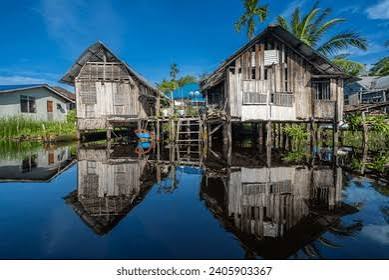
No one seems to know where the name of Melanau came from. It has been designated to a group of people who lived along the mouths of the Rejang, Blawi, Palo, Bruit, Egan, Mudan, Oya, Muka and Bintulu rivers. They number about 30,000.
Among the Melanau, one Englishman observed that people from one river could not understand those from another, and those living in these river valleys tended to live in cultural and political isolation from each other. They identified not as Melanau, but as people from a certain river.
The people who would be called the Melanau were Austronesians, a group that migrated from Taiwan to the Philippines and then down the Sarawak coast to the Sambas River thousands of years ago. Most of the coastline was swampy, not conducive to rice farming or other forms of agriculture, but it did have the sago palm tree, which grew in a watery environment.
Sago was known from prehistoric times, possibly before rice cultivation. The tree was cut down before flowering, the pith scraped out and washed until the starch fell to the bottom and then dried. Women mixed sago flour with salt and water to form a stiff paste. They put the paste on a flexible mat and flapped it back and forth until it formed small round pellets. When they were large enough, they were placed on the hot surface of a clay stove, fueled by sago bark, and rolled with a whisk. (Morris, p.223)
One could obtain 130-165 kg of sago from a single tree, enough to last a family for months. At that time, sago was produced for local consumption.
Before Singapore’s establishment in 1819, sago was traded as locally baked round pellets sold in bags. The Melanau people, as we shall call them, did not have trade items. They were obliged to export sago and jungle items they obtained from people living in the upper reaches of the rivers. They needed to import salt, metal, cloth and most other items. A barter economy was set up whereby traders could obtain foodstuffs in exchange for needed items.
Trade in spices and other commodities declined in the early 1800’s and merchants needed something to pick up the slack. Sago began as a small trade item and was exported to Britain in 1813. In 1814, the Chinese discovered a way to refine sago further into flour. By 1824, this method of refinement was introduced into Singapore. Most sago came from Sumatra, but by the 1840s, sago was exported from Brunei’s sago coast. However, trade demanded the sago be further refined into a dry flour and then carried to Singapore.
The refinement and transport of this flour became the monopoly of Brunei merchants. This new sago market became so valuable that the Sultan’s representatives in Mukah and Oya attempted to establish a monopoly. (Morris, p. 231) By the 1830s, local Pengirians were competing with Brunei merchants.
When Brooke took over in 1841, he spent the next twenty years trying to rule the area. After the British Navy withdrew its help in the 1850s, he was left with no allies but the Iban.
“Sarawak had no trade. After 1842, a small trade began to spring up, but the pirates and sea dayaks rendered the pursuit of trade very difficult. Without trade revenue, Brooke had to rely solely on his personal income. In the first three decades of Brooke’s rule, Sarawak relied on the export of jungle products and mineral ores.
Facing bankruptcy, he realised he had to divert most of the sago trade profits away from Brunei and towards Kuching, or his government would not survive. The people who purchased the sago flour were Malay. They bought crude, unrefined flour from the villagers, while in Brunei and Singapore it was turned into a more marketable product. A sago factory was built in 1856 in Kuching. The Chinese and Europeans owned the factories that further refined the sago.
The White Rajah’s interest was that sago passing through Kuching, whatever the quality, was taxed. The overriding concern was redirecting the flow of sago away from Brunei and towards Kuching and Singapore.
The Rajah of Sarawak ceded the sago district, mainly the towns of Oya and Mukah, to the Kingdom in 1861. He paid Sultan Omar Ali Safiuddin 4,000 Spanish dollars. From sago income, the Raja’s income stabilised.
The Brookes’ governance of the sago region was difficult. Language was a major problem. The Melanau village organisation was different from that of the Malays and Ibans in Sarawak. The Melanau did not speak Malay, nor did many of them relate to the many dialects on each river. There was no unified language. It was better to leave it to the Chinese to quasi-govern and collect the tax rather than attempt to collect it from the local Melanau.
In the 1870s to 1900s, Chinese traders would take their boats to the kampongs and anchor them. They collected the sago and transported it to the seaside. From there, larger boats sent it to Kuching, where taxes were collected, and the sago was further refined. The refined sago was exported to Singapore, where it was sold worldwide.
The Melanau aristocrats were excluded from this trade. However, a very old pagan aristocrat could recall stories of his forebears taking sago to Brunei, Pontianak and Johore in exchange for cannon, brassware, ceramics and cloth. (Morris,p. 17)
By 1900, the establishments for the production and export of sago were set and would not change for the next fifty years. A cottage industry in the kampongs produced the crude flour. Chinese intermediaries bought the flour and, by then, had it refined in Mukah, much closer to the source. From there, the refined flour was shipped to Singapore.
Prices paid for the raw flour were based on the barter method. The Chinese would record the payment for the sago in a book. Merchants set the price in Singapore. The Melanau would purchase items from the Chinese such as salt, metals, cloth and other imports. The cost of the goods would then be deducted from the book. Very little, if any, cash was exchanged between the buyer and seller.
Although a wide variety of Chinese would be involved, i.e., Hokkien, Hakka, Teochew, and Chu, they managed to keep their trade profitable. The Chinese families Ong, Lim, Song, Teo, and Kueh kept a stranglehold on sago production, from purchase in Mukka from the Melanno to export in Singapore, for many, many years. The Brookes would allow the Chinese to control the sago economy as long as taxes continued to be paid on the flour.
Tom McLaughlin for BorneoHistory.net
Much is owed to Steve Morris, who wrote The Oya Melanau in 1991, a 414-page tome.
Morris, Stephen. The Oya Melanau. Kuching: Malaysian Historical Society, 1991
Wong, Lin Ken. The Trade of Singapore, 1819-1869 in JMBRAS December 1960
Other groups, such as the Kinnahs and Kayans who lived in the Barram River; the Kanowits, Kajamangs, Bakatans, Lugats, Ukits, Tanjongs and Punans of the upper Rejang; the Tattus, Balineans, Bakatans of the Upper Oya and Mukah and the Malows of the upper Kapuas are distinctly the same stock.