
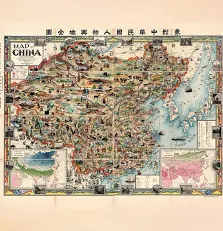
The Early origins of the Chinese who migrated to Borneo
When I first moved to Kuching,I wanted to try to understand the Chinese people. I soon learned they were divided into different peoples from different parts of China, each with their own dialect, history and customs. Below, please find an explanation of how this happened and the status of each group before they began their migrations. I know I am missing a few of you, and I hope you will tell me who you are so I can research for a later article.
There were two groups of early arrivals into China. To the south, the Yue people were already established by 4000-3000 BCE. In the north, the Huaxia people were a group of tribal people who lived along the Yellow River. They formed the Yangshao and Longshan Neolithic cultures beginning around 5000 BC. They coalesced into the Han people around 221 BCE.
The Han people would begin their southern migration with their own Han-related dialect, their own customs and beliefs. They would move in their own time, solidify in a group and occupy their small part of China. Some people would remain inland growing rice, while others would expand to the coast and become seafarers.
The Han people would begin moving south, and these migrations would form the following groups, which would move into Borneo and other Southeast Asian places at a much later date.
Hokkien
The Hokkien developed in the coastal Fujian province. Fujian province is historically known as the Min and is a coastal area of southeast China. The Han Chinese, who migrated down from the Yellow River valley, make up most of the province.
The Hokkien evolved from the mixture of the Han Chinese and the local population who already lived there. The people who already lived there were the Minyue settlers from the southern Chinese population. The Han, who invaded in 111 BCE, mixed with the Minyue and formed the Hokkien. They formed the distinctive Hokkien culture around 618 AD.
Teo Chew
Lying immediately southwest of Fujian is the province of Guangdong. Within that province are the Teo Chew or the Chaozhou. They arrived in the Chaozhou area about as early as 2000 BC. The Teo Chew are Han Chinese who migrated from the north and mixed with the Yue population who were already living there. They formed a distinct group around 900 AD. Their language is similar to Hokkien, but since they mixed with the Yue dialect, it has deviated away from Hokkien.
Hakka
The Hakka are Han Chinese who coalesced into a distinct group in the Shantung Province in about 300 BC. There was a persecution of the group in 255-209 BC, and they fled south in several waves beginning in 220 CE. There were several more persecutions, and they became involved with several groups borrowing bits and pieces of dialects from others, but their dialect is closer to Mandarin. They settled in the mountain and inland areas of Meizhou, West Fujian, South Jiangxi and northeast Guangdong. The four areas are known as the Hakka Heartland.
Foo Chow
The Foo Chow are Han Chinese who also moved south during the 3rd century CE. They are from a different genetic stock, and they did not mix with Minyue as their fellow Chinese did. This makes them physically taller and more robust. The Hokkien and the Foo Chow were separated by a rugged mountain range, which caused, over thousands of years, their dialects to diverge.
Cantonese
The Cantonese are another major subgroup of the Han Chinese. Their homeland is around the Pearl River region of Gangdong Province. They mixed with the Nanyue people who were already living there. The Cantonese developed in the fertile Pearl River. They emerged as a people probably around 220 BC.
Hainanese
The Hainese migrated to Hainan Island off of China from about 206 BC to about 220 AD. Large numbers of settlers arrived in 618-1279 AD. They are a mixture of the Han Chinese and the Li people who already lived there.The Li people were assimilated into the arriving Han Chinese.
Yue
The Yue people were non-Han Chinese who lived in southern China around 1 B.C. They were likely Austroasiatic people who formed the Vietnamese, Thai, Burmese and other groups. They were rice farmers, fishermen, boat builders, traders and skilled bronze workers. They formed the Yue Kingdom (600-300 BCE)
Minyue
The Minyue are an ancient people who lived in South China before the Han migration. They established a Kingdom in Fujian in 206 BC, but it collapsed during the Han invasions, which began in 111 BCE. Their language is unknown. They are thought to have emerged as a people about 2000 BCE-500 BCE.
Tom McLaughlin for BorneoHistory.net
Select bibliography
Chu-Yuan Cheng Chaozhou People and Chaozhou Culture in the American Journal of Chinese Studies April 1997
Li Hui et al. Origin of Hakka and Hakkanese: A Genetics Analysis Acta Genetica Sinica (Yi Chuan Xue Bao) 30(9), 2003
Norman, Jerry. The Min Dialects in Historical Perspective. Journal of Chinese Linguistics Monograph Series, No. 3 (1991).