
Before the Austronesians and the Chinese
The cause of the last ice age has to do with Earth’s orbit around the sun, the tilt of the earth on its axis and the wobble of the earth. These are called Milankovitch cycles. These cycles came together to form the last ice age or glacial maximum as scientists like to call it which began 115,000 years ago. Earth temperatures dropped because there was less sunshine reaching the northern part of the planet. Ocean currents changed not allowing warming waters to reach northern climates. Increased ice and snow caused sunlight to be reflected back into space.
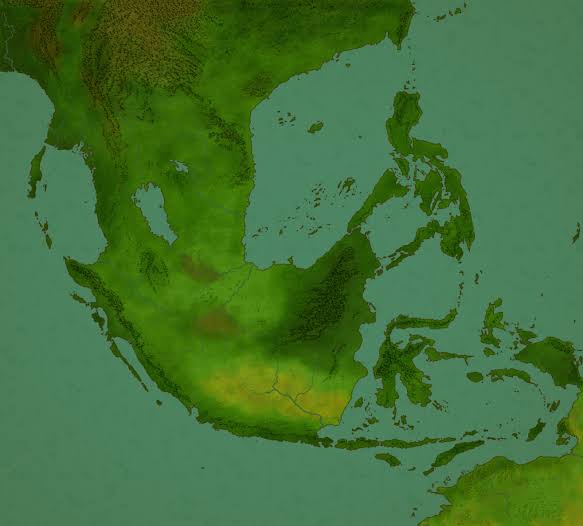
During this time, humans walked out of Africa and into Southeast Asia about 60,000 to 50,000 years ago during this ice age. They could walk back and forth between Sumatra, Malaya, Java and Borneo as the ocean waters were locked up in ice. As the land cooled the land became savannah like attracting animals . It was believed this land was windswept plains and they were probably following herds of cattle. The land mass is called Sundaland.
While travelling eastward, they probably met up with an archaic human called Denisovans. We think they probably had large teeth, robust jaws, and looked something like the Neanderthals. Both Neanderthals and Denisovans lived and thrived during the ice age so that would be an educated guess.
There is no evidence the Niah people met and bred with the Denisovans but most researchers believe it was certainly possible. They could have walked across Sundaland and probably inter bred with Denisovans about 50,000-70,000 years ago and had children with them. It is not known whether the Denisovans were in Borneo but, remember it was a giant land mass called Sundaland.
At Niah caves, one of the skulls was dated at 45,000-50,000 years ago. We know they were here and most certainly had arrived from their journey from Africa. Niah climate at that time was probably cool with vast savannahs making travel easier before the seas would rise again and form the vast mangrove swamps which would guard the entrance into interior Borneo along the coast.
Genetic studies would tell us where the Niah people came from and when but there are various reasons why we have no genetic studies from Niah Caves. The tropical climate does not preserve DNA. Tom Harrisson excavated the graveyards in such a haphazard manner in search of the “missing link” making any preservation of genetic material impossible. Sterile conditions for retrieval of the bones were ignored by Harrisson. Genome sequencing is expensive and extracting DNA is also difficult. There is no collaboration between museums, government agencies and international laboratories.
A group of people who have been extensively studied are the negroid people of the Philippines. Their DNA suggests they descend from the earliest humans about 50,000 years ago much like the Niah people. They have a large component of Denisovan ancestry in their genes. However, the Philippines is separated from Sundaland by deep sea channels. They must have taken boats from Borneo across the channels to the Philippines.
As the earth continued to warm and the ice melted people became isolated. The South China Sea formed. Individual groups of humans became trapped in Sumatra, Malaya, Java and Borneo. We don’t know who they were but do know they carried Denosovan genes. They were possibly hunters and gathers who raised pigs, made stone tools, hunted deer and gathered fruits, nuts and wild plants. From these populations the Austonesians would interbreed on their migrations south. Researchers think hunters and gathers lived here and the Austronesians later mixed with them.
There is very little information on what happened between the Niah Caves of 60,000-40,000 years ago and about 7,000 years ago with the arrival of the Austronesians. We can guess that the first inhabitants arrived 50,000 years ago. In 26,000-19,000 years ago the climate became colder and drier. The South China Sea became land. Then, about 19,000 to 11,000 the warming began and the seas reformed.
Very recent genetic studies have shown that people living in Borneo today are very distantly related to the humans who wandered around Borneo ~7,000 years ago. In the Kelabit Highlands there are also signals of human habitation ~7,000-~6,000. Rock art in East Borneo show habitation about 13,600 years ago. A rice grain was dated to 4000 years ago from Gua Sireh near Bau indicating Austronesoian people brought rice with them.
The people who live in Borneo today are mostly derived from the Austronesian migration from Taiwan. Those who are not related to the Austronesians are the Punan/Penan, people of the Niah Caves , negrito populations of the Philippines and the Chinese.
Tom McLaughlin for BorneoHistory.net
Sources consulted:
Curnoe,Darren et al Deep Skull from Niah Cave and the Pleistocene Peopling of Southeast AsiaFront. Ecol. Evol., Sec. Paleontology 27 June 2016
Graeme Barker et al. The ‘Human Revolution’ in Lowland Tropical Southeast Asia: The Antiquity and Behavior of Anatomically Modern Humans at Niah Cave, Journal of Human Evolution. 2007
Jinam, Timothy Discerning the Origins of the Negritos, First Sundaland People:Deep Divergence and Archaic Admixture in Genome Biological Evolution July 2017
Kusuma, P., Cox, et al Deep ancestry of Bornean hunter-gatherers supports long-term local ancestry dynamics. Cell Reports, 42(11), 113346.2023
Maximilian Larena et al. Multiple episodes of Denisovan admixture in the Philippines. Current Biology 31(18):4219–4230.e10 2021
Reich, David, et al. Denisova Admixture and the First Modern Human Dispersals into Southeast Asia and Oceania. The American Journal of Human Genetics89(4):516–528.2011
Yew et al.“Genetic relatedness of indigenous ethnic groups in northern Borneo to neighboring populations from Southeast Asia, as inferred from genome-wide SNP data”Annals of Human Genetics 82(4):216–226 2018