
Religion and Smelting at Santubong
Java traders from about 0-1350 AD experienced periods of trade booms followed by downturns of trade depression. The cycles of trade were based on Chinese interests in Southeast Asian products. The 10th- 13th century was viewed as the height of Javanese-Chinese trade. Java people traded with Borneo, as Hindu artefacts found in Borneo were similar to those found in Java.
Metallurgy had a long history in Southeast Asia. Bronze technology dates to the third millennium in Thailand. Iron became a factor in the first millennium. Iron smelting sites were known in Thailand from the 5th to the first century BCE, Kedah from the 5th to the 14th century AD and Cambodia from the 9th to the 13th century.
There were four major metallurgy sites, and they had their own distribution center. Kedah processed iron ore to satisfy the Indian Ocean trade. Thailand pioneered iron smelting in the northeast. Cambodia combined making agricultural implements with temple construction. Santubong, it was thought, exported most of its iron to China; however, Jan Wisseman Christie, a noted researcher, disputes this. He states most of Santubong’s iron was used in local Borneo and Indonesia. It was probably both.
Early smelting began in east and central Java in the 5th century before the Christian era. By the 1st- 4th century CE, iron smelting became linked to agricultural tools and early weapons such as spears. Early known sites on Java were found at Trowulan, dated to the 13th to 15th centuries; on the Dieng Plateau, during the 8th and 9th centuries; the Prambanan Temple complex in the 9th century; and the Gunung Kidul regions in the Southeast.
Java was rich in agricultural products such as rice and spices but poor in metals and stones, which flaked into tools such as flint and obsidian. There was a great need to import metals. Traders brought raw iron from Kedah and Santubong to be smelted locally.
The iron of Santubong was found on the ground in granules (pisolitic laterite). The iron working period of Santubong ranges from 615 AD to 1360 AD. Slag, the residue of ironworking, is scattered over miles of coastal swamp. The amount of slag is estimated at over 40,000 tons over 300 years, and crucibles were found, which indicate this was a major iron-producing area. Santubong is the only known iron smelting area on Borneo.
The idea of metal working and religion can be seen in the kris. The blade has a long history in both craft and religious symbolism. The Malays believe in a sort of magic called tuju, where the kris could have magical properties, and the metal kris could bring bad luck,
The origin of the kris is uncertain. One Western theory is that it evolved in Central Java before the 14th century. According to Stamford Raffles, the kris was present in a forge scene carved into Candi Sukuh, which has been dated to 1361. Weapons have been identified in carvings at Borobudur in the ninth century, but none can be positively identified as a kris.
Ironworking was not just a technical craft but deeply tied to spiritual beliefs. Smiths were seen as mediators of cosmic forces, and metallurgy was also linked with ancestor worship. Hindu- Buddhist worship and animistic beliefs were part of the picture. Iron transformation symbolised the transformation of the soul, making the forge both a workplace and a sacred sanctuary. Santubong was distinctive in combining religion with smelting.
An irregular area, covering 1,000 square feet at Santubong, is a bed of pebbles. Beneath the pebbles, fifty whole high-fired Chinese ceramics as well as gold amulets, glass beads, bronze bangles, and other valuable objects were found. This deposit was clearly ritual in character. There is a considerable amount of iron slag above the pebbles, presumably spread there because of its magical properties. At another site, Bongkissim, also on Santubong, three to six inches below the platform, there were buried pieces of iron slag. This arrangement of the slag-pebbles-artefacts is also known in Java and India.
Boulders and carvings can be seen with the metal working sites. There is a stretch of open dry land where sandstone boulders have been worked into a series of carvings that are deliberately mysterious, ambiguous and open to multiple interpretations.
The best known figure is the spread-eagle carving, half life-sized, locally called Batu Gambar. He wears a curious headdress and is linked to the mountain, almost certainly regarded as sacred, and to the ground, at the base of the boulder, to the iron slag. The other carved boulders are similarly linked to the slag, which seems to be a mix of the iron operation, slag and carvings.
When you compare the stone carvings on Santubong with those on Java, both have Hindu-Buddhist carvings, although Santubong’s are modest and ritual-focused while Java’s are much grander.
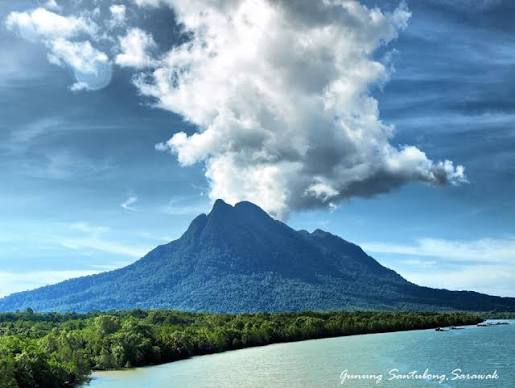
The concept of mountains also has a religious significance. They were thought of as the abode of the dead, the powerful ancestors who may be contacted on their slopes. Mountains such as Mount Poppa in Burma, Vat Phu in Southern Laos and the Buddhist sanctuary of Doi Suthep in north Thailand, as well as Mount Santubong, are all a continuation of the worship of mountains.
On the island of Java, mountain worship began on volcanic slopes on Gunung Padang around the turn of the millennium and also at Cibalay Punduk Burunduk around the same time and possibly earlier. Mt Merapi and Mt Berbabu are two volcanic mountain peaks that were considered holy by the Javanese.
These four sites date to the foundation of iron working on Mt. Santubong. When you connect these mountains to Mt Santubong in mountain worship, you have the possibility of Mt Santubong being a centre of worship by the Javanese. This added to the religiosity of iron production indicates a Java connection.
These four sites indicate that Mt. Santubong could also have been a mountain that was venerated along with the iron working on Mt. Santubong.
The idea that the iron workers considered working with iron a spiritual endeavour, as evidenced by the pebble field with slag -pebble- artefact layer and the carved boulders, all indicate these blacksmiths had come from Java.
This whole constellation of evidence- the trade and travel of the Javanese, their veneration of the smelting process, the geometric figures on the boulders, plus Mt. Santubong seems to indicate a Java presence. Santubong rose as a major iron-working centre not only because of the rich deposits of pisolitic laterite (iron)but because of the profound religious significance wound into the site.
Selected References
Blakelock, Eleanor Slag Inclusions in Iron Objects and the Quest for Provenance in Journal of Archaeological Science vol.36, #8, August, 2009
Christie, Jan Javanese Markets and the Asian Sea Trade Boom of the Tenth to Thirteenth Centuries AD in Journal of Economic and Social History of the Orient vol. 41, no. 3, 1998,
Christie Jan On Poni: The Santubong Sites of Sarawak in Sarawak Museum Journal 55, Dec 1985
Frey, Edward. The Kris Oxford: Oxford University Press, 1986
O’Connor, Stanley J. Iron Working as Spiritual Inquiry in the Indonesian Archipelago in History of Religions vol 14, no. 3, Feb. 1975
O’Connor, Stanley J Metallurgy and Immortality at Candi Sukuh, Central Java, Indonesia, vol. 39, Apr 1985
O’Connor, Stanley Trade and the Santubong Iron Industry, World Archaeology vol 2, no. 1 June 1970
Tacon, Paul New Engravings discovered at Santubong Sarawak in Sarawak Museum Journal, 2010
Tom McLaughlin for BorneoHistory.net