
Smallpox and Borneo
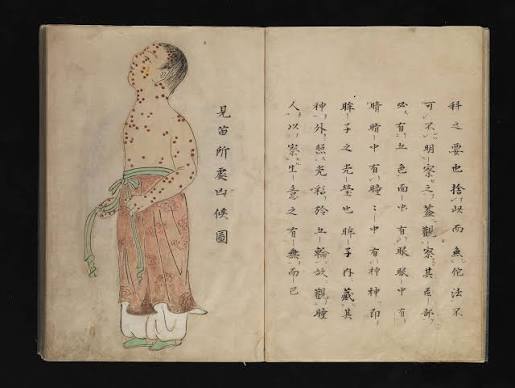
The earliest description of smallpox was in China in the 4th century. By the Ming Dynasty (1368-1644), Chinese physicians practised variolation by drying smallpox scabs, grinding them into powder, and blowing them into the nostrils of healthy children. This method probably began around 1000 and was not very common until the 1500’s, when it was popularised in ancient Chinese medical books.
In India, specialists travelled from village to village in the 17th century, carrying smallpox material and inoculating children. Shitala was the goddess of smallpox, and poems to her were prevalent in the 17th and 18th centuries.
In Penang, medical officers offered the first vaccination service in 1805. In 1808, the service ended after repeated failures due to heat. Penang later became a vaccination centre for the Straits Settlements.
In Singapore, shortly after the colony was founded, William Farquhar requested vaccine supplies from Penang in 1819. The first campaign struggled, and the Vaccine Department was abolished in 1829, but further vaccination efforts continued because smallpox remained common. · By the 1860s, the colonial government was discussing compulsory vaccination and importing fresh vaccine lymph from England and Java. The Straits Settlements enacted a Vaccination Ordinance in 1868, covering Singapore, Penang, and Malacca.
In Batavia, now Jakarta, the Dutch used variolation before 1804. After that date, Jenner vaccination became known and widespread inoculation campaigns began throughout the Indonesian region.
The first documented smallpox case in Borneo was in 1734 in the Sambas area. Smallpox reached Southeast Borneo in 1734, 1750-1, 1764-5, and 1778-9, or about once every 15 years. Usually, smallpox arrived during the east monsoon, when dry conditions facilitated transmission. Calculations showed smallpox epidemics every 12 years before 1820 and every six years between 1821 and 1860 for Borneo as a whole. (Knapen, p. 12)
The Malays of Sarawak were likely variolated through the bomohs in the kampongs. They likely learned variolation from those who returned from Mecca and through the Arab world. It is doubtful the Brooke regime would have provided the expensive Jenner vaccine to the kampong people.
The Chinese had been familiar with variolation for hundreds of years and probably brought the technique with them to Kuching. Chinese medicine shops probably provided the service. (Some historians state variolation came late to the Chinese of Borneo(Knapen, p. 12), but this is doubtful. It was probably part of the Chinese medicine shop kit)
The Dayaks would have no immunity to the disease, as they did not practice variolation, as witnessed by the major epidemic outbreaks. Oral history of the Ibans suggests smallpox was prevalent in the 17th century.
For inoculation, the Dayak usually relied on coastal Malays, who demanded exorbitant payments for the treatment (Roth, 1896:i.291-2). Malays inoculated several hundred Dayak during the 1856 epidemic in Southern Sarawak, and only three died as a result.
The Dusun of North Borneo believed in the god of smallpox, Bisagit. Bisagit would come for his men once every 40 years but would take only half the population.
James Brooke had full-blown smallpox soon after he arrived in Kuching from England in May 1853; therefore, he did not contract smallpox in Kuching. Smallpox has a two-week incubation period. He carried it with him from another port. He travelled from Ceylon to Singapore and then on to Kuching via “the China line”.
The Arab Sheriff Moksain and three Malay servants attended him. They must have been variolated/vaccinated against smallpox to survive nursing Rajah Brooke. No evidence shows that Brooke was ever vaccinated against smallpox. (This includes examination of his medical records in India and his records as a soldier, via AI). The severity of his disease indicates this. Reasons he may not have been vaccinated include that vaccination had a reputation for being unreliable, variolation was regarded as a legitimate alternative, and vaccination made people uneasy because it was new. Brooke could have thought he would never get it.
In the Kayan, over 3,000 died of the disease in 1857; 1,333 Kayans perished. Entire communities were lost, and longhouses were emptied. Haji Unus, a Selimbau Malay from the Kapuas River Valley, inoculated 3,600 people during the Baram epidemic. (I question this number)
A major smallpox outbreak hit Brunei in 1904. The epidemic began on Labuan in the Malay kampong of Victoria Harbour. The disease spread throughout the area, and people rushed to Kampong Ayer and Brunei town to escape it and brought smallpox with them.
The Brunei epidemic was probably caused by the Dyaks who were not vaccinated/variolatedand who came to Brunei and Labuan for work from other locations, as was their tradition. It is noted that only the younger members of the Sultan’s family died, and they were probably not vaccinated against the disease.
The town of Brunei was divided into 11 different wards. Even as late as 1904, residents did not know about Jenner’s vaccination. The acting consul reported to the high commissioner that the pox was “most prevalent” in the Sultan’s kampong and the kampongs surrounding the palace.
The British maintained a large cutch factory there. Cutch was used to preserve fish nets and sails, tan leather, and produce brown dye. They cut up mangrove bark, boiled it, and evaporated the liquid. They formed the remaining residue into blocks or balls for export. It was thought the British delayed information about the epidemic to keep workers at this factory.
It was reported that Sultan Hashim practised variolation rather than Jenner’s vaccination, believing variolation was vaccination. Sultan Hashim harboured no love for foreign imperial personages. He loathed everything about the British.
Even with variolation, the disease still spread. The Sultan lost a son, three grandchildren and eight younger children. It is unclear whether the Sultan’s extended family were variolated, whether this was a particularly virulent form of the disease, or whether the inoculum the bomohs used was effective.
The variolation of the kampong people was carried out by a Haji Muhammad. He said Allah had put it into his head to perform variolations to stop the epidemic. He performed 2,000-3,000 variolations, taking whatever the kampong people could afford to pay him.
A call went out to Saigon and Singapore for Jenner’s vaccine. However, the Sultan preferred his kampong methods of variolation over imported European methods.
By the time the Jenner vaccine arrived, smallpox had already spread through the country. The doctors arrived at the tail end of the smallpox epidemic and inoculated only 57 people with the Jenner vaccine. The doctors did not go to the outlying areas.
Efforts to get the headmen to use Jenner’s vaccination instead of variolation proved fruitless. The Kampongs and the city resisted strongly.
About 10% of the Brunei population died during this epidemic, according to historian A.V.M. Horton, which, according to his estimates, is about 1,000.
Smallpox in the Malay and Chinese communities was minor because the Malays and Chinese practised variolation techniques. The people who acquired smallpox were the Ibans, Bidayuhs, and other native peoples, and, of course, Rajah James Brooke, who caught it on his return voyage home to England. Where he caught such a violent strain and why he wasn’t vaccinated/variolated remains a mystery.
Compiled by Tom McLaughlin for BorneoHistory.net
References:
Boomgaard, Peter. Smallpox, vaccination, and the Pax Neerlandica: Indonesia, 1550-1930. Bijdragen tot de Taal-, Land- en Volkenkunde , 2003, Vol. 159, No. 4 (2003) very little information on Borneo
Early Career of Sultan Hashim in Borneo History.com blog 30 December 2014
Early Records Of Inoculation And Smallpox Vaccination In Sarawak | KajoMag March 11, 2020
Horton, A.V.M. The Brunei Smallpox Epidemic of 1904 in Sarawak Museum Journal December 1984
Templer, James, editor. The Private Letters of Sir James Brooke, Rajah of Sarawak. London: Richard Bentley, 1853
Knapen, Han. Lethel Diseases in the History of Borneo 1700-1900: Mortality and the interplay between disease, environment and human geography. Paper for the First Conference of the European Association for South-East Asian Studies, 29 June – 1 July 1995
Knapen, Han (2001). Forests of Fortune? The environmental history of Southeast Borneo, 1600-1880. Leiden: kitlv Press.
Fenner, Frank. Smallpox in Southeast Asia in Crossroads vol. 3/no. 2/3 1987
Templer, James, editor. The Private Letters of Sir James Brooke Rajah of Sarawak. London: Richard Bentley, 1853
Ulbe Bosma, Smallpox, Vaccinations, and Demographic Divergences in Nineteenth-Century Colonial Indonesia, Bijdragen tot de Taal-, Land- en Volkenkunde, 2015, Vol. 171, No. 1 (2015). Very little information on Borneo