
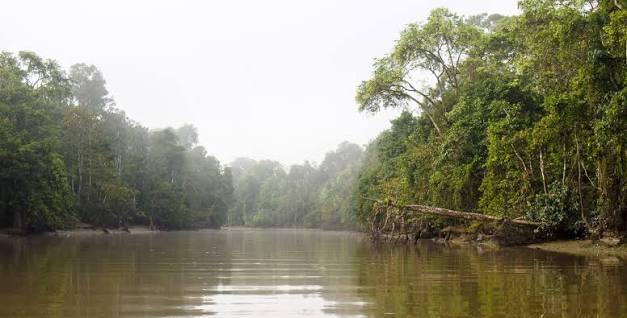
Tulin River
During the Brunei Sultans’ rule, they owned the rivers the Bajau people lived along. They maintained a feudal-like control in which the Sultan delegated authority to others. When the British took over, they dismantled this system and paid the “owners” for their control of the rivers.
A Tulin is a hereditary title for those rivers in North Borneo where the Sultan or a member of his family maintained control. The holder or owner could collect taxes, control trade, exercise administrative authority, and receive income from the people along these rivers. There were a dozen or so rivers which were called tulin.
The Tulin River concept held that a Sungai Tulin River is personal property inherited by its descendants. Only the owner of a Sungai Tulin river has the authority to lease or transfer a Sungai Tulin to other parties. Traditionally, the Sultan of Brunei and his friends did this.
Pengiran Abdul Rauf was designated as one of the individuals who owned several tulin rivers. Research from UMS (University of Malaysia Sarawak) indicates he was an important leader of the Baju communities on the west coast of North Borneo.
A 1822 Jawi document states that Pengiran Jalaluddin conveyed ownership rights to the Mengkabong and Kinarut rivers to him. (Here things get complicated. There were two Pengiran Jalaludins. The first one lived around 1822 and the second one around the 1890’s)
However, other research indicates ownership of the Mengkabong River was transferred to other members of the Brunei Sultanate in 1851. A dispute arose from the lease agreement dated 20 November 1891 between Pengiran Jalaludin and the British North Borneo Company. The question was who really owned the Mengkabong River. According to the sequence, Rauf inherited the rivers from Jalaludin 1 in 1822. Then Rauf’s son, Jalaudin 2, inherited the rivers from his father. Jalaudin 2 then leased the rivers to the British North Borneo Company.
Another source says the Sultan of Brunei transferred the Mengkabang River to Pengiran Muda Muhammad Jamalul Alam in 1851. This discovery shows that two elite Bruneian families disputed ownership of the Mengkabong River. This challenged the idea that Pengiran Rauf and his heirs owned the river exclusively.
In addition, the lease agreement documents show that another group of pengirans, the heirs of Pengiran Anak Muhammad Salleh, also owned Sungai Menggatal and signed an agreement with SBUB in 1898. Three groups were involved in the ownership of the two rivers.
The lease agreements Pengiran Jalaludin signed with the British North Borneo Company in 1891 and 1898 sparked protests because they covered territories not entirely under his ownership. This situation led to new lease agreements in 1898.
By 1898, the British North Borneo Company brought all the Tulin Rivers under its control through territorial lease and surrender, regardless of who claimed ownership. The British signed two agreements: one with the individual owners of the Tulin Rivers (March 23, 1898) and another with the Sultan of Brunei (March 30, 1898). (March 30, 1898).
By 1907, “The Sultan and his friends had to surrender also their Tulin rights together with a large part of cession monies and monopolies. In return, they received compensation in the form of a fixed sum of annuities, much like the other Malayan nobility in the Peninsula.
In Brunei’s case, the Sultan and his Wazirs were paid $12,000 and $6,000 per annum, or $1,000 and $500 per month, respectively, to be revised later when the State enjoyed better times. They, however, were allowed to retain some land surrounding their residences for which they were exempt from paying rates, rents or any other charges.
Sultan Hashim Jalilul Alam was too old then to grasp the significance of his personal loss of lands. In any case, he could not override the British Resident while the principal Wazirs could scarcely raise a banner of protest, having been accused of trying to sell off the country to Rajah Brooke of Sarawak.” (Hussainmiya)
This process not only illustrates the weaknesses in Brunei’s traditional ownership system, but also shows how colonial intervention exploited internal elite conflicts to consolidate territorial control.
Compiled by Tom McLaughlin for BorneoHistory.net
References
Fatmah Sidek HAK PEMILIKAN SUNGAI TULIN PENGIRAN ABDUL RAUF DI PANTAI BARAT UTARA BORNEO(1822-1898) Hak Milik Pengiran Abdul Rauf ke atas Sungai Tulin di Pantai Barat Laut Borneo 1822-1898 MANU Bil. 37 (2), 110-117, 2026 (Disember
Fatmah Binti Sidek1 & Bilcher Bala2 Socioeconomics of the Sungai Tulin Pengiran Abdul Rauf Region in Borneo North (1822-1898)translated from Sosioekonomi Wilayah Sungai Tulin Pengiran Abdul Rauf Di Borneo Utara (1822-1898)
Sidek, F. B., & Bala, B. (2021, December). Sosioekonomi wilayah Sungai Tulin Pengiran Abdul Rauf di Borneo Utara (1822–1898) [Conference paper]. Conference held in Sabah, Malaysia. (researchgate.net)
Dr Haji B. A. Hussainmiya, Sungai Tulin Coming of Age: Role of State Council in Brunei, 02 November 2015, Borneo History.Com
Tarling, Nicholas. Britain, the Brooks and Brunei. Kuala Lumpur: Oxford University Press, 1971
M:35/82, JQ710GRA, 0056008, C.O. 874/54
Grant of Menggatal, Mengkabong, Api-Api, Simbulan, Nafas, and Tambalang River
23 March 1898