
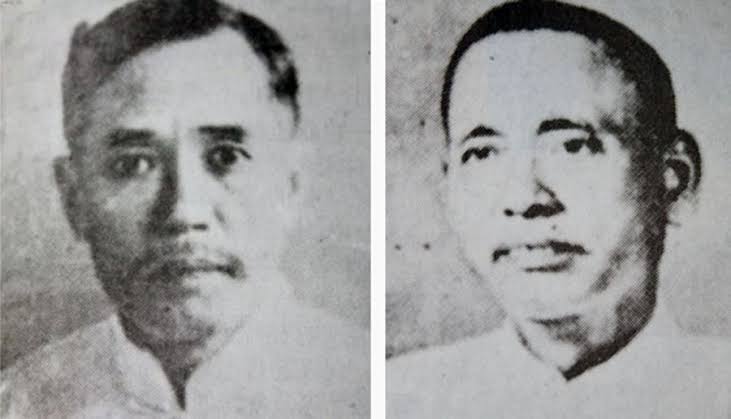
The History of Kwong Lee Bank of Kuching
The founders of the Lam concern came from Jiangdam, Guangdong, China. However, their arrival in Singapore is uncertain. Kuching records state that Lam Tee Chew (林子昭) came from Singapore in 1905, rented No. 30 Main Bazaar, and started the Kwong Lee Mortgage and Remittance Company. His brother, Lam Song Khee, came from Singapore to help expand the company. The Lam family was an important banking and entrepôt business in Singapore in the early 1900s and financed the early venture.
The culture of the times indicated people didn’t store money in banks. They placed their money and trust in Chinese shopkeepers and remittance houses where their money was transmitted to China.
A remittance company would send money to a person in China. Imagine a person in Kuching. He would deposit the money with the company. The company would then arrange for its offices in China to deliver the money to his family. The bank made money from the fees charged to the sender for the transfer. There were also differences in currency exchange rates, usually favourable to the bank.
There were other ways for the Chinese to send money to China. A Chinese merchant or money changer would make arrangements for funds to be delivered to people in China. Usually these were within the particular clan. For example, Teo Chu would deal with Teo Chu shopkeepers and money changers, and Hokkien would deal with Hokkien money changers and shopkeepers.
Chinese shopkeepers would keep an account of the funds deposited. Purchases were deducted from these deposits. Transfers to China were also deducted from the total amount deposited.
The family records of Kwong Lee Bank indicate the concern provided money for trade using pepper, rubber and other commodities as collateral to secure the loans. They became involved in pawnshops, gold mining and sago processing.
The company charged high interest rates of 52% per annum. As it collected interest payments in advance, it provided little assistance in the accumulation of wealth by the local Chinese.
The Lam family opened branches in Sibu in 1923 and Singapore in 1926 and converted to Kwong Lee Bank in 1934. The Sariki Bank opened the Binatang branch in 1937 and in 1973. Singapore’s OCBC acquired a 52% majority from the Lam family in 1964, while Tunku Osman acquired a 30% share in 1977. In 1982, MUI acquired an 82% stake. The whole concern was acquired by Hong Leong Bank in 1994.
The collapse of the worldwide economy in 1929 and the onset of the depression brought problems for the bank. The price of Southeast Asian commodities collapsed, and heavy losses suffered by Chinese merchants dragged down the business of Chinese banks.
By the early 1930s, Chinese banks operating in Malaya, Singapore and Sarawak had taken steps to reduce inefficiencies commonly associated with Chinese family businesses. Reforms were introduced that led to the adoption of corporate structures and modern business management. The bank became Kwong Lee Bank in 1934.
The following is taken from Chen Tsung Yuan, Historical Institutional Analysis of Ethnic Financial Institutions: A Study of the Chinese Banks in Sarawak, Malaysian Journal of Chinese Studies, 2013, 2(1)
“The Japanese army occupied Sarawak and soon seized all three Chinese banks in operation then. The Japanese suspended the business activities of Bian Chiang Bank, Kwong Lee Bank, and Wah Tat Bank, and appointed the Yokohama Specie Bank to terminate their operations. They were later merged to become Kyoei Bank. This new bank had no tangible assets, and the currencies issued by the Japanese military authority became valueless after the war. The assets of the Chinese banks built up before the war vaporised and were completely lost.
From the end of the Japanese Occupation to the Asian financial crisis of 1997, Sarawak’s banking industry experienced dramatic changes in its institutional and economic environment. The outbreak of the Korean War in 1950 raised rubber prices to record levels and energised Chinese business and the banking industry. However, as rubber was a global commodity subjected to wide fluctuations in prices, the stimulus of high demand for rubber to the local economy was short-lived.”
“The end of the Korean War saw the rise of the timber logging industry as a major economic activity in Sarawak as it replaced rubber as the primary export. The logging business’s hefty financial investments were largely drawn from Hock Hua Bank. The prosperity of the timber business then had reportedly enabled the Foochow community to accumulate great wealth, and Hock Hua Bank and other financial institutions helped to propel the new phase of development of Sarawak.”
“The period of the mid-1950s and early 1960s saw the formation of political parties. The British colonial government encouraged political consciousness, possibly to groom Sarawakians for independence through merger with the Federation of Malaya.
“This period also coincided with the beginning of the timber industry. Chinese merchants engaged in political activities or the timber industry were able to build close ties with the government and gain access to business opportunities and licences. These developments contributed directly to the business of Chinese banks. As a result, a new generation of bankers, among them Ling Beng Siew and Wee Hood Teck, was able to reach out to local “high society”.
In May 1982, the bank was taken over by the MUI group and its name changed to Malayan United Bank.MUI Group was a Malaysian business conglomerate involved in banking, property, hotels, retail and other commercial activities.
On January 3, 1994, the Malayan United Bank was taken over by Hong Leong Group Malaysia, and its name changed to Hong Leong Bank. (This is not to be confused with the Hong Leong Group in Singapore, which the Kewk family owns) The Hong Leong Group is invested in insurance, investment, property and hotels.
Compiled by Tom McLaughlin for BorneoHistory.net
References:
Shahibi, Fadzlan Kwong Lee Bank: A Bank that Started in Kuching and Today we Know it as Hong Leong Bank Here-There-Everywhere – Updating the Family Banking from 1905. Corrections to this account appeared later, on 1 October 2026.
Chen Tsung Yuan, Historical Institutional Analysis of Ethnic Financial Institutions: A Study of the Chinese Banks in Sarawak, Malaysian Journal of Chinese Studies, 2013, 2(1)