
Pirates in the South China Sea
Letter from James Brooke, the first White Rajah of Sarawak, to the Editor of the Straits Times in Singapore June 4, 1862.
To the Editor of the Straits Times.
My Dear Sir.
l promised to give you occasional news from this coast, but until now there has been nothing of importance to communicate. You have no doubt heard of the Ulanum pirates(pirates from the south Philippines) who yearly turn out in large fleets from Sulu, Tawi-Tawi, and the neighbouring Islands(south Philippines yet north of Sabah Borneo) and ravage the coasts of Java, Celebes, and Borneo.
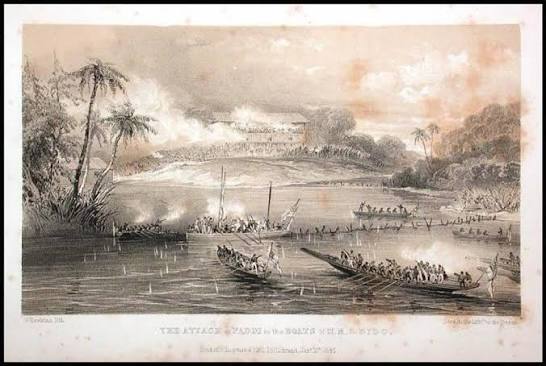
On the 21st instant(instant meaning this month), I was lying at anchor in the ‘Rainbow,’ a Sarawak steamer, at the mouth of the Bintulu river, having just returned from the interior, where we had examined the coal seams recently discovered, when an express boat came from Mukah, the great Sago river,(sago is a flour harvested from palm trees and widely used in cooking in Southeast Asia) from the agent of the Borneo Company,(a British company based in Kuching) to say that six large Illanun (pirate ships from the south Phillipines) boats were passing along the coast.
They had killed several people, and taken great numbers captives, including several women they had also chased several women, the boat that brought the despatch, and only escaped on account of her speed. (They had killed several people and taken many others prisoner, including several women.The boat carrying this report managed to escape them only because it was faster than their boats.) The ‘Rainbow’ and a gun-boat were immediately prepared for action, and steamed out over the bar, the Bishop of Labuan being on board.
On the 23rd, at daylight, three of the enemy were discovered from the mast-head(the highest part of the mast) about seven or eight miles to seaward ; chase was immediately given. As we approached all doubt of the character of the boats vanished. We could distinctly see that they were crowded with men and straining every nerve to get on shore before the steamer ‘ Rainbow’ got up, which the leading boat effected, running her on the rocks at Kadurong Point.(We could clearly see that the boats were packed with men, all struggling desperately to reach the shore before the steamer Rainbow arrived. The leading boat succeeded, but ran aground on the rocks at Kadurong Point.)
As the steamer passed by, in two fathoms(3.6 meters or two feet) water, the pirates opened fire on her from their muskets and lelas (small Malay cannons) ; this was returned with interest, and after ten minutes, cannonade the survivors ran into the jungle (this boat was afterwards made prize by the Bintulu people).
The steamer then attacked the other two boats, one of which she ran down ; the other, previously clearing her well out with grape, was brought alongside. (The steamer then attacked the two remaining boats. She ran into and sank one of them. The other had already been badly hit by her grape shot (small metal balls fired from a cannon), so the steamer pulled alongside it. She was full of captives, men, women, and children, who were taken on board and the wounded attended to by the Bishop.
From one of the boats we took one Spanish and five Dutch flags, and not less than sixty captures were taken from the two boats. Shortly afterwards the other three boats were fallen in with further at sea, and utterly destroyed. (We captured one Spanish flag and five Dutch flags from one of the boats. We also captured at least sixty people from the two boats. A short time later, we encountered the other three boats farther out at sea and completely destroyed them.)
Out of these, who made a desperate fight of it, killing and wounding several in the steamer, and even fighting in the water, the steamer took on board thirty of the illanum (pirates), who were punished and put into the hold, and about seventy captives.
There were men, women, and children of many nations, Boyans, Bugis, Javanese and the Nakoda and crew of a large tope (large sailing vessel used to carry cargo in Southeast Asian waters) sailing out of Singapore, which had been captured, and four of her people killed near Caramatta (islands and Strait between the South China Sea and the Java Sea) ; a woman and her child belonging to Kampong Glam ; people of Sambas, Pontianak, Triganu, Boyan, Matto , Mukah, and many others. (small towns along the coasts of various islands)
Each of the Lanuns boats(pirate boats) contained about 100 persons, 40 of whom were Lanuns,(pirates), the rest captives. (Lanuns were Muslim seafaring pirates from the southern Philippines) The cruelty inflicted on these poor wretches, crammed into their boats, is terrible. They were nearly starved, given salt water to drink, and for the first few months of their captivity, they were disabled by having their knees and elbow joints beaten with bamboos.
There is another fleet we have obtained information about, that after assisting at the capture of the Singapore Tope near Caramatta, crossed over to Banea and Billiton(Islands off the south Sumatra coast). In ten days or a fortnight from this time, they will in all probability return to this coast on their way homewards with their plunder and captives, and if a man-of-war is quickly dispatched to Bintulu she would have an excellent chance of freeing many poor captives and punishing their miscreant captors.
I beg that you will urge this on your Governor, and the naval authouties. — I am truly, &c, J. Brooke. Sarawak, May 27, 1862.
Tom McLaughlin for Borneohistory.net
This clipping from “Looking into the Past of Sarawak Borneo” by Veronica Chang Schmid 24 September 2026.