
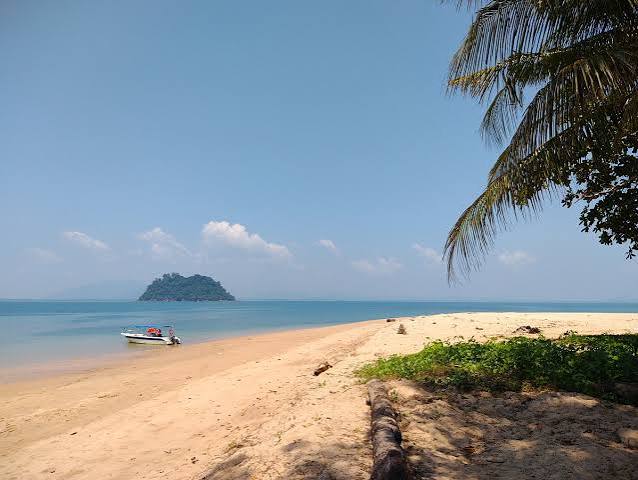
Santang Island
After hearing an oral history about a massive meteor shower over Santang Island, and that people loaded boats to take the metal to Santubong for processing, I decided to go out to the island and see for myself whether the story could be true. This occurred possibly around 800-1200 A.D., but I felt it was worth a look.
I wanted to find meteorites that might have been left over from the possible meteor shower. I needed a magnet which would attract the meteorites, as they were mostly composed of iron. First, I needed a strong magnet, which was available on the e-commerce site, Shopee, but it wouldn’t arrive in time for my trip.
I searched Kuching, and most hardware stores didn’t carry magnets except refrigerator-door magnets, not the strong type I needed. On a hunch, I went into an electrical shop, and the owner gave me a piece of a magnet from a disassembled motor. It was strong enough, and I was forever grateful.
Armed with my magnet, I set out for Telega Air, a small Malay fishing village facing the South China Sea and the boat to Satang Island. I travelled with three others to cut the cost of the RM520 round-trip boat ride. The boat ride to the island took about 30 minutes, and we landed on a sandy beach. I ambled up the beach and was surprised by how primitive the island was, given how heavily it was advertised to tourists. Pieces of plywood stood on legs, with stools around them under some trees.
I sat down, picked up some rocks, and tested them to see if they reacted to the magnet. I made a small pile of these stones; none showed any metal. I then walked down the beach to a massive rock fall. Here, tons of stones had slid down the mountain ages ago and littered the beach.
I climbed into the centre, sat on one of the larger rocks, and tested stones within my grasp which could have been meteorites, making small piles. They showed no magnetic reaction. I guess I spent about an hour testing various rocks which looked like they might be meteorites.
I wanted to climb the steep slope in the centre of the island and look for other candidates, but I couldn’t find an entrance or path up the hill. Besides, I was told it was too dangerous to try and hike up the slope. I decided my meteorite search had come to an end.
I looked around the island for any signs of where people could have worked the metal, slag, pits, or other debris, but found nothing. I searched for possible landing places where boats could have pulled up on shore loaded with iron ore and then travelled back to Santubong, a day’s paddle, as I was told, but there was no harbour-like place to land.
I went to look for the turtle station run by the Sarawak Forestry Department and found a Bidayuh person who had been up all night collecting turtles which had just hatched and would be released the following night. I sat and chatted with him about his job, and he was very diligent in stopping poachers from stealing turtle eggs to sell on the black market.
He told me about the leper colony that once stood there, a Japanese ship that sank off the island during World War II, and a recording that played bird calls to attract the swifts, who made nests for bird-nest soup. I left my magnet with him, and he assured me he would contact me if he found any magnetic rocks.
I departed the island and studied the waters. I realised that a paddle boat in olden days could not load up with iron and travel to Santubong. It just seemed too far to carry a load of iron. But I could be wrong.
When I got back to Kuching, I sat at my computer and did some research. There wasn’t much. A letter from James Brooke, dated 1855, said he was going to Satang Island to see if there was any copper to mine there.
A Japanese ship built in Nagasaki in 1912-1913 was torpedoed off Santang Island. It was discovered in 2003 and used as a dive site. Later, people stripped it of anything valuable and finally mined it for scrap metal. Only the hull remains now. I really don’t know what value the metal would have after being in salt water for over 75 years.
The leper colony was transferred from 5th Mile in Kuching to Satang Island in 1924. They built a series of wooden huts with concrete slabs and transferred 76 lepers there. It closed in October 1925, just before the monsoon season, because the site was inaccessible. Supplying this isolated island would have required a long boat ride, and the journey would have been almost impossible during the monsoon season.
I also found other mentions of the island: James Brooke came to the island looking for copper in 1855. Fishermen caught Trobok, whose roe the Chinese considered a delicacy.
The following is a description taken from a book written by the naturalist Orlando Beccari in 1904:
“I went across in my sampan, but should not do it again, for on our return we had a narrow escape of being swamped, a heavy sea having got up very suddenly. River boats are certainly not safe, even for a short trip at sea.
Satang Island is mostly formed by a small hill, partly granitic and partly sandstone, on the south side, whilst its northern portion, farthest from the mainland, is limestone, rising in cliffs which overhang the sea. Here I found plants which I had not met with elsewhere, but on the southern, nearer end the plants were identical with those on the sea-shore at Sibu.
On the calcareous rocks overhanging the sea I saw edible nests of a species of Collocalia, but they were quite inaccessible. Along the eastern side is an extensive sandy beach, on which turtles come ashore to deposit their eggs. Here is the landing place, opposite the hut of a man in charge of the island, who not only collects the turtle eggs, but takes care of a coconut plantation.
During the night I remained on Satang several turtles landed to lay their eggs, which are deposited in a hole about 2 feet deep, to the number of from 100 to 180, and are then covered up with sand so cleverly as to leave no trace of the operation. The turtle which resorts to Satang Island is the green turtle Thalassochelys caretta, a species found also in the Mediterranean, and very abundant along the shores of Malaysia and in the Indian Ocean.”
Compiled by Tom McLaughlin for BorneoHistory.net
References
Beccari Odorado Wanderings of the Great Forests of Borneo London: Constable 1904 p 98
Crocker, William M Notes on Sarawak and North Borneo in Proceedings of the Royal Geographical Society Feb 14, 1881
James Brooke Letter 18 February 1855 WCP 3793
Katori Maru Wikipedia, the free encyclopedia
Sarawak Gazette, November 1, 1927, Supplement page 15