
Spain and North Borneo
Spain’s desire to colonise the Philippines became clear when it named the islands after Prince Philip in 1543. The inauguration of the Manila Galleon route in 1564 between Manila and the Americas consolidated Spanish power.
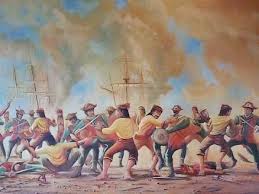
Spain then dispatched its authorities to colonise other areas of the Philippines. One of these areas was the land ruled by the Sultan of Sulu, who also ruled North Borneo. The Spanish maintained an ambivalent relationship with the Sultan. On the one hand, there was mutual and peaceful trade. On the other hand, inhabitants attack Spanish shipping through piracy. The latter were Muslims who acquired the nickname of Moro.
The Spanish did attempt to spread Christianity to Brunei through the Castilian War of 1578. The Spanish briefly occupied the capital, marking the only time Spanish forces controlled Brunei. However, they faced resistance, disease, and logistical challenges for their occupying forces, and withdrew their army.
The Jesuits, a catholic evangelical group, wanted to extend their influence southward during the 17th century. A war was fought with the Sultan of Jolo with the aim of bringing him under Jesuit and, hence, Spanish rule. The Sultan of Sulu occasionally became embroiled with the Spanish, and peace treaties were signed but routinely ignored by the Sultan. Peace treaties were signed in 1646, 1713, and 1737, as well as with other groups under the rule of the Sultan, including those in Borneo in 1685 and 1705, and others on the island of Mindano in 1645, 1719, and 1794. Mindano, unlike Borneo, was considered part of the Spanish area because of their proximity to the Visayas Islands.
The Sultanate of Sulu maintained an independent course mainly because it was so far from the Spanish centre of power in Manila. However, a treaty signed in Madrid in 1744 stated that any enemy of Spain was also an enemy of Sulu, and Sulu was to stay out of any European War.
The early nineteenth century saw a shift in Spanish policy. Madrid sought a closer relationship with its colonies in the Philippines. Previously, they had been seen as a mere extension of their colonies in America. This brought about an attempt to bolster influence and to protect the inhabitants of the Philippines from other colonial powers..
Six naval stations , three around Mindano and another three around the Visaya’s, were constructed. North Borneo was beyond the scope of these stations as the station at Zanboanga was responsible for controlling piracy from Sulu.
Because of the weakness of the Spanish in the area, the Sultan of Sulu was treated as a friendly power. However, this reciprocal treatment changed in the mid-nineteenth century, when interest in the islands in the Sulu Sea began to rise within France, England, the Dutch and other European powers.
On the island of Borneo, England began to penetrate Borneo under the rule of James Brooke. James Brooke and his commercial network established themselves with China as a result of the First Opium War. Brooke’s rapid consolidation of power in Sarawak shifted from an informal influence to a more stable colonial system. He was granted the principality of Sarawak by the Sultan of Brunei (Omar Ali Saifuddin II) in an agreement signed on 24 September 1841.
Brooke also succeeded in negotiating the cession of the island of Labuan to the United Kingdom via a treaty signed and ratified with the Brunei Sultan in 1844. Following this, British captain Munday took possession of the island on 24 December 1846 and transformed it into a British colony in 1848. The United Kingdom used its base in Labuan and Brooke’s friendly local relations to convince the Sultan of Brunei to sign a treaty on 27 May 1847, in which he promised not to lease land to any other nation without British authorization. British settlement in North Borneo was also ratified by the Sultan of Sulu, in a treaty signed on 29 May 1849.
Following Brookes successes, the American, in 1842, signed a security agreement with the Sultan of Sulu to protect United States boats, it was not approved in Washington. In 1843, France tried to establish itself in Basilan with a treaty with the Sultan of Sulu. Another attempt with another treaty was made in 1845; however, Spain said Basilan was part of their empire. The French withdrew their claim, figuring Basilan was not worth a hassle with Spain.
As a result of the Sultan of Sulu negotiations with the Americans and the French, the Spanish led punishing raids against the Sultan in 1845 and 1850. Another expedition was launched in 1851, and a treaty signed by Spain and the Sultan stated: “The island of Sulu and its dependencies are incorporated into the Spanish Crown, which has been its sole protector for several centuries.”
As the imperial process accelerated, agents from other powers viewed the large island as a place to colonise during the final third of the nineteenth century. This was the stance taken by the United States, Germany (in 1866, the international press reported that Prussian traders were preparing a trade agreement with the Sultan of Sulu as a result of their large trade flows); Austria (in 1875, Austria threatened to seize land on the northern coast of Borneo unless it received an explanation for the murders of the crew of the corvette Frederich in May 1875. This did not ultimately come to pass; Italy (the scientific expedition of the Governolo in 1872–1873 persuaded the Muslim authorities to cede Malludu Bay, following the plan set out in the memoirs of Felice Ciordano concerning ‘the establishment of Italian colonies in the northern part of the island of Borneo’41); and the United Kingdom especially. The latter was able to consolidate its presence in the area of Sabah on the island thanks to the establishment of the English Overbeck-Dent Company. As a result, it considered North Borneo to be British territory.
The origins of the Overbook-Dent agreement, which resulted in the formation of Sabah, may be traced to an agreement signed by an American, Claude A. Moses and the Sultan of Brunei in 1865. This allowed them to set up a trading company on the Kimanis river. The search for funding brought Moses to Overbeck from Austria, who acquired all the rights and debts to the project. Failing to find funding in Austria, Overbeck succeeded in obtaining funds from the Dent Brothers in England. In 1877, they signed an agreement with the Sultan of Sulu in exchange for an annual payment to him. This became the legal foundation for the British North Borneo Company
The Spanish with England in 1885, signed whereby Spain permanently relinquished all claims to Borneo in recognition of all claims by Spain to the Sulu Sea. In the Treaty of Paris in 1898, Spain gave control of all the Philippines to the United States.
The Spanish never did have any control over Borneo except by association with the Sultan of Sulu. Although Spanish authorities invoked historical ties with the Sultanate of Sulu and attempted to restrict the sultan’s foreign relations, they never incorporated Borneo into the legal or administrative framework of the Philippine colony, nor did they establish effective occupation.
From:
Cosano, David Diplomatic Claims and Imperial Realities: Spain and Northern Borneo in the Nineteenth Century The International History Review 2026 DOI: 10.1080/07075332.2026.2638845
Tom McLaughlin for BorneoHistory.net