
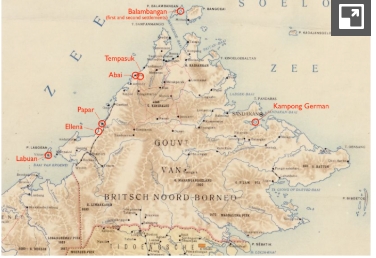
Colonies in Sabah
Balambangan
One of the earliest attempts to establish a foreign settlement in Sabah took place on Balambangan Island, off the northern tip of Borneo. The idea came from Alexander Dalrymple, a British official working for the East India Company. In the early 1760s, he made agreements with the Sultan of Sulu that allowed the British to use the island.
Another British official, John Herbert, set up a small settlement there. It was meant to be a trading post linking China with Southeast Asia. The British traded with local Tausug and Maguindanao merchants. These traders were connected to the Sultanates of Sulu and Maguindanao in what is now the southern Philippines.
The British exchanged local products such as birds’ nests, pearl shells, and sea cucumbers—items that were very valuable in China—for opium and weapons like muskets and gunpowder.
The settlement did not last long. Herbert offended Datu Teteng, a relative of the Sultan of Sulu. In February 1775, Datu Teteng led an attack and destroyed the trading post. The East India Company lost a great deal of money and did not return to Balambangan for many years.
The British tried again in 1803, this time bringing soldiers and supplies. However, fears of war elsewhere caused them to leave the island again in 1804. This ended Britain’s early attempts to settle Sabah.
Papar
In the late 1870s, two businessmen, Alfred Dent and Baron von Overbeck, tried to establish new settlements in Sabah. One of these was at Papar.
Papar was not a good place for a settlement. It was open to attack and difficult to defend. The main government building was made of weak materials and had no strong defences. The first official in charge made little progress and was later replaced by A. H. Everett.
Everett focused on expanding political control, which caused problems with local leaders. One such leader was Datu Amir Bahar of the Bajau people, who refused to pay taxes. In 1880, Datu Amir Bahar gathered a large group of followers and threatened the settlement.
Although fighting did not occur, many settlers felt unsafe. More than one hundred families eventually left Papar.
Labuan
Another British settlement was established on the island of Labuan. Britain hoped to use Labuan as a naval base and trading port. Some even believed it could become as successful as Singapore.
However, Labuan faced many problems. The island often became swampy during the rainy season, which led to sickness among the people. Trade was slow because there was little investment, and the coal found on the island was poor quality and hard to mine.
The Royal Navy also showed little interest in using Labuan as a base. As a result, Labuan remained small and unimportant, although it was never abandoned. For many years, it was Britain’s only base near Sabah.
Ellena
In 1865, an American company tried to set up a settlement called Ellena at the mouth of the Kimanis River. The settlers included a small group of Americans and Chinese workers from Hong Kong.
The company hoped to control large areas of land and build a private territory similar to Sarawak. However, the settlement faced serious problems. Many people fell sick, and food was scarce. One of the leaders died of fever, and the company ran out of money.
Even though land was cleared for farming, the settlers could not grow enough food. By 1866, Ellena was abandoned, and the survivors returned to Hong Kong.
Tempasuk and Abai
In 1878, a British company sent William Pretyman to manage a settlement near the Tempasuk River. He made agreements with local leaders and forced rival groups to make peace. In one case, a local chief who resisted company rule was captured and sent away.
The Tempasuk settlement had a problem: ships could not easily enter the river. To solve this, a new port called Abai was built near the coast in 1879. Abai grew quickly, with houses and small industries such as salt-making.
Over time, Abai became more important, while Tempasuk was abandoned.
Kampong German
In 1873, a small trading post called Kampong German was set up on an island in Sandakan Bay. It was used by traders to secretly sell goods such as weapons and opium to the Sultanate of Sulu, avoiding Spanish control of the seas.
Several German traders were involved, which is how the settlement got its name. Kampong German was well protected and used small ships to travel between Borneo, Jolo, and Singapore.
In 1877, a treaty between European powers ended the Spanish blockade. Once trade became legal again, Kampong German was no longer needed and was abandoned.
From:
Michael Yeo Before the Port City: coastal settlements and colonialism in Borneo Urban History (2025), 1–15 doi:10.1017/S0963926825100266
Compiled by Tom McLaughlin for BorneoHistory.net