
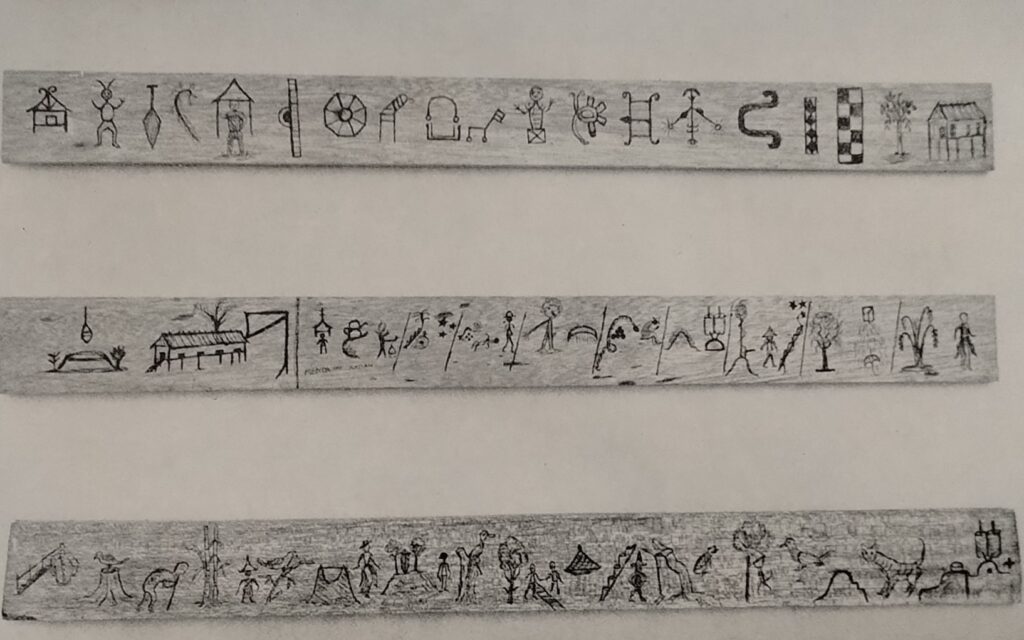
The Borneo Writing Boards
I have always heard about the Iban writing system and was told they had a written language. I kept trying to find the alphabet to hopefully translate some of the writings on the cliffs on islands in the bays around the area. I finally did a full research effort. There was only one major article that I could find, written by Iban scholars Tom Harrisson and Benedict Sandin, and independently disputed by other Iban experts, Anthony Richards and S. Gill. Tom Harrisson was and is a very controversial researcher whose information is questionable. Benedict Sandin continues to be a well-respected scholar, especially when translating Iban into English, but what was written by Harrisson and what was written by Sandin cannot be teased apart from a joint paper.
Very little is known about the picture board writing. It possibly dated back to the 1500-1600’s when the Iban migrated into the Sarawak area from the Kapuas river valley in central Borneo. The writing boards could have existed before then . They could possibly have brought this notation system with them from other areas. The writing did not convey a sound but conveyed a meaning. Each symbol represented a certain concept.
The Sarikas Writing Boards
Two men, Tom Harrisson and Benedict Sandin, wrote a paper in 1966 describing these boards. Harrisson’s entire lifetime scholarship is questionable, but Sandin’s is not. It is very difficult to separate the work of the two, which includes translations, into a 225-page paper.
The pictures on the boards were meant to help beginning shamans memorise the stanzas used during various ceremonies. For example, the “Sick Chant” contains 31 six-verse lines. The picture board contains cues on triggering the memory of each sequence. Each picture cues the next event in the chant’s storyline.
Another example is the stanzas for the “Jar Festival Chant”. This chant has 37 stanzas that contain between four and 23 lines. The board connected with this chant has pictures which tells what happens next in sequential order.
Each board is unique to each Lambangan or shaman. One board cannot be read by another shaman even though it may cover the same chant. The boards are unique to the chant and to the author who drew the pictures on the board. The shaman has memorized all of the verses; however, he uses the boards and their symbols to trigger the memory for the next stanza. Two men, Harrisson and Sandin, wrote a paper in 1966 describing these boards. Harrisson’s scholarship is questionable, but Sandin’s is not. It is very difficult to separate the work of the two in a 225 page paper.
Anthony Richards responds
Anthony Richards was an Iban expert in Sarawak. In a review of the above Harrisson- Sandin paper, Anthony Richards (1967) states that text verses are not related to the symbols on the boards. The texts are” used as a basis for an account of myth and belief obtained from a small group of Dyaks in the Saribas.” Richards continues that” It is contended that the ‘writing boards’ are an essential record, a canon of scripture and secret: He says they are neither. It is also said that the boards are not used anymore and ‘the writing is thus dead’. Sandin accuses Harrisson of incompetence and dishonesty.
Harrisson- Sandin respond
Harrisson responds to Richards(1968) charges by stating the Saribas are just as typical as any other Iban, two of the writing boards came from Saribas, while two “came from over 100 miles away”, the boards were not made to order and Richards rejection of the idea that they are not an essential record (for what were they for?).
Mr Richards replies(1968)
” The Saribas Iban differ from the majority to such an extent that the omission of all reference to the differences gives a distorted view. Statements made about them, or any other branch of the Iban community, are not necessarily true of all Iban.”
The Iban who were 200 miles away were also Saribas Iban. If the boards were not made to order, it would be unlikely they would part with them. The boards cannot be written records in any accepted sense, because it is not possible to understand every symbol without instruction from the individual who drew it.
Mr. S. Gill, another Iban expert of the time, raises the question :” do the characters(on the board) in fact constitute an indigenous Borneo script or “script in embryo” as Hedda Morrison suggested in 1957?” and as an answer states ” Since each of the papan turai characters appears to record a cluster of ideas, they may function as complex visual images, symbols of concepts, not of sounds, and may thus belong instead to the rich and evocative language of art, not of speech.”
We can see from the above exchanges that the interpretation of the Saribas writing boards was controversial.
A Kalimantan Writing Board and the Mamat festival by Tom Harrisson
In a separate paper in the same 1967 booklet, Harrisson states that the Leppo Tau Kenyahs of Long Nawang, upper Apo Batang Kayan on Borneo are regarded as the repository of culture. The board is used to record the suhan (ranks) taken in the Mamat. The Mamat is a great feast of these people, while the suhan is a grade taken by the participate during the festival. The grades are given for the age of the participants with the first boy receiving a pair of tweezers while the oldest warrior, at 27 years from when the boy receives the tweezers, given the right to sit on three heads. These are all recorded on the writing board.
The PapanTuri Gawai Batu 517
An article was written by Aldrin John Hew in the Sarawak Museum Journal December, 2024. Copies of the December Journal were not on the internet, in the Tun Jugah Library, in the Sarawak Library or in the Museum Gift Shop. I had to go to the main office of the Museum in Kuching to get one.
The board 517 is housed in the Sarawak Museum. It was drawn by Lembang anak Kutak from Nakat Bakong in 1963, either for Harrisson (as Richards contends) or obtained by Tom Harrisson and later donated to the museum. Lembangan is an honorific term meaning keeper of the old ways.
The Gawau Batu is an annual festival celebrating stones that sharpen the blades that cut the rice plants at harvest. The work was either translated or drawn or both by Lembangaan Imban anak Kutak. Lemambang means the keeper of the oral traditions.
An article(Aldrin) in the Sarawak Museum Journal, December 2024 describes the symbols on the board 517 housed in the Sarawak Museum. Aldrin lists the humans, spirits and other entities which connects to the chants of the Gawau Batu and are drawn on the boards. It does not connect the pictures on the board with individual chants. You have a series of pictures on a board which somehow connects to the chants of the festival.
The essay divides the characters painted on the boards into groups such as human and animal figures. The spiritual figures then come from a list inside the chants. They are not pictured on the boards.
The next essay by Norahim in the same issue discusses these same two boards and also discusses the sharpening stones. Norahim concurs and disputes with Richards, that Lembang anak Kutak created these boards for his use to help him memorize the long dirges in 1963.They(among others) were then turned over to Harrisson and Sandin for analysis and then to the museum. The history of the Iban is not written on these boards, they only trigger the memory to recite a chant which, possibly, contains the history.
Continuing on with discussing the same boards, Gregory Kiyai anak Keai, in the same issues, discusses the arts and aesthetics of the boards. He states that the Iban never had a specific writing system and individuals innovated by createing an idiosyncratic scheme in the form of images and carvings painted on a memory board, namely Papan Turai to help memorize the oral history and genealogy of the Iban people.
According to Lembangan Unsa, researchers understand that the Papan Turi Gawai Batu boards are a functional art concept used by Iban Lemambang to memorise every sequence in the oral tradition of the Iban, continues Keai.
In discussing the art, Keai informs that the figures on the boards are images found in other Iban works of traditional art, such as the pua kumbu ,tikai bebuah and other wood carvings. It is known as the Engkeramba motif.
Interwoven with the descriptions of the boards is a record and a translation of the oral, memorised accounts of the Papan Turai chants. Harrisson, if indeed it was Harrisson and more likely Sandin, must be credited with a heroic effort to record and translate these chants. Aldrin also uses these chants to describe the “spirits” contained in these chants. However, they have nothing to do with the actual boards and their drawings describing the chants, that I can figure out.
The following statement was made by Dr Ernisa Marzuki, Faculty of Education, Language and Communication at UNIMAS in UNIMAS Gazette Home 2024 May 8 The Sarawak Hieroglyphics:A Lost Legacy.
“There were dozens of symbols which recurred but Leo Nyuak and Edm. Dunn, who first wrote about the writings in 1906, did not make an exact count.”
Nyuak and Dunn never wrote about the Iban Turai Script in any of the three 1906 articles below.
Nyuak, Leo and Dunn, Edmund Religious Rites and Customs of the Iban or Dyaks of Sarawak in Anthropos Bd. 1, H. 1. (1906), pp. 11-23; Bd. 1, H. 2. (1906), pp. 165-184; Bd. 1, H. 3. (1906), pp. 403-425
Interwoven with the descriptions of the boards is a record and a translation of the oral memorized accounts of the Papan Turai chants. Harrisson, if indeed it was Harrisson and more likely Sandin, must be credited with a heroic effort to record and translate these chants. Aldrin also uses these chants to describe the “spirits” contained in these chants. However, they have nothing to do with the actual boards and their drawings describing the chants, that I can figure out.
________________________________________________________________________________
Aldrin John Hew Documentation and Analysis of the Papan Turai Gawai 517 in The Sarawak Museum Journal , special issue no. 11 Papan Turai Gawai Batu 517 December 2024
Gill, S. Borneo Writing Boards: A Review in Asian Perspectives 1967
Harrisson, Thomas and Sandin, Benedict Iban. Writing Boards in Man, March 1968
Harrisson, Tom, ed Borneo Writing and Related Matters Sarawak Museum Journal Special Monograph #1 Harrisson, Tom and Sandin, Benedict Borneo Writing Boards Sarawak Museum Journal Nov.1966 p.32-224
-Bijdragen tot de Taal-, Land- en Volkenkunde, Deel 121, 1ste Afl., ANTHROPOLOGICA VII (1965)
Jensen, Eric The Iban World in Sarawak Special Monograph No.1 Borneo Writing and Related Matters Nov.1966, p. 29 Papan Turai Writing Boards
Kiyai, Gregory anak Keai Art and Aesthetics in the Papan Turai Gawai Batu in The Sarawak Museum Journal , special issue no. 11 Papan Turai Gawai Batu 517 December 2024
Harrisson, Tom, ed Borneo Writing and Related Matters Sarawak Museum Journal Special Monograph #1 Harrisson, Tom and Sandin, Benedict Borneo Writing Boards Sarawak Museum Journal Nov.1966 p.32-224
-Bijdragen tot de Taal-, Land- en Volkenkunde, Deel 121, 1ste Afl., ANTHROPOLOGICA VII (1965)
Marzuki, Ernisa The Sarawak Hieroglyphics:A Lost Legacy in Unimas Gazette May 8,2024
Norazuna Norahim Papan Turai Gawai Batu:Historical Significance in The Sarawak Museum Journal , special issue no. 11 Papan Turai Gawai Batu 517 December 2024
Richards, Anthony Review of Borneo Writing and Related Matters, edited by Tom Harrisson. Man (N.S.) 2, 1967 : 488–489.
Tom McLaughlin for BorneoHistory.net