
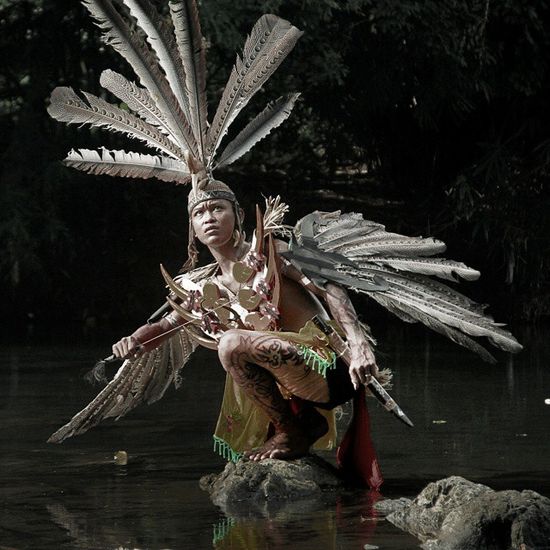
Origin of the Malays and Ibans
There is an old theory, still making the rounds, that the Iban arrived here from Java or Sumatra. There is currently no genetic or archaeological evidence to support this idea.
From the last essay, we established that the Bidayuh were among the first Austronesians to leave Taiwan, visit the Philippines, travel down to Sungkung, and become established in West Borneo. They then divided into four or five specific dialects and migrated inland.
The gap between the arrival and settlement of the Bidayuh and the Malay-speaking group was about 2000-3000 years. The Malayic people, who would become the Malays and Ibans, came much later than the Bidayuh and spoke a much different dialect than the Bidayuh. They followed the same migratory path, Taiwan-Philippines-coast of Borneo, and then also settled in western Borneo. These people probably met the Bidayuh who were living there. They became the Iban and the Malays.
There were only a few places for the migrating Austronesians to land and to make a settlement along the coast of Borneo. Most of the coast from Sabah to Indonesia was covered in mangrove swamps, totally unsuited for farming or building houses. There were slow rivers that meandered through them with entrances impeded by sandbars. The belt of swamp forest along the Sarawak coast varies from two to twenty miles wide. It was very difficult to penetrate inwards. The people kept moving until they reached Southwest Borneo, where upland hills and the Kapuas and Sambas Rivers allowed them to settle and farm.
However, the newcomers did not speak Bidayuh. They probably spoke one of the dialects of Austronesian that developed when the proto-Austronesians came to Taiwan thousands of years ago. This was a different group of people, probably from a different settlement on Taiwan. This language became distinct and different, and some think it morphed into Malayic while the people were living in Southwest Borneo about 1,000-500 years ago. From this point in Southwest Borneo, the language and the people migrated to Sumatra and then to peninsular Malaysia and spread the language to other areas.
As time marched on, it became clear these new people who developed the Malayic language transitioned from farmers and became traders that stayed long enough to develop the new language. Some continued on with the migration, carrying the Malay with them, settling and trading along the rivers and streams of Borneo, Sumatra and Malaya. From this group came the Malays, Minangkabau, Banjar and Kerinchi speakers, while in Borneo, they morphed into the Ibans, Kendayan, Salako, Embaloh and other Malayic speakers.
From this common origin, the people separated. The group we call the Ibans migrated up the Kapuas and Sambas rivers and established themselves along their banks, while the group we call Malays ventured further afield, travelling to Sumatra and then to the Peninsula.
For about 1000 years, possibly more, the Malay world spread from Southwest Borneo. This would mean for about 40 generations, the Malays spread ever so slowly into Sumatra, establishing the Bataks and Minangkabau people. Similarly, the Iban would have spread, again slowly, up the rivers dividing relentlessly away from the Malays. The language would change, but very, very slowly.
As they settled in Sumatra around 500 BC-200 AD, the Malays met the Indians, who began their migration south in about 300 BC and began to settle with the Malays who arrived later. They travelled from India, through Sumatra and then all the way to Java. On their journey east, they met the Malays. They changed some of the Malays from their animistic ways to Hinduism and Buddhism. Some people think the Malay-speaking people became “Indianized” and took names, stories and culture from the Indian community, while others feel it was the Indians themselves who spread the Hindu-Buddhist faith and still others feel it was both.
One of the customs of the Malay royal family was to leave their homeland and strike out and find new lands to form a kingdom. A royal member would gather together an entourage and search for a suitable place to settle. They brought their Indian acquired customs with them.
In this way, the Malays then backtracked to Borneo and established kingdoms along the Kapuas and Sambas River valleys. These kingdoms include Kutai, Brunei, Sambas and Sukadana. One kingdom established by the Malays was the Tanjungpura Kingdom, which would give rise to the Santubong Kingdom in 966.
We know the Ibans broke off from the Malays, probably in Southwest Borneo about 1,000 years ago, but retained the Malayic language spoken by both the Ibans and Malays. The Ibans probably migrated up these river valleys to find more land for their slash-and-burn cultivation.
Tropical soils are nutrient-poor. There is no leaf fall to provide a replacement layer to rejuvenate the soil. The Ibans had no choice but to continuously move up river to cut down trees, burn the land and then plant crops. Once the soil had been depleted of nutrients, they moved on. The crops planted were hill rice, maize and cassava.
However, the planted fruit trees took time to develop and succeeding generations of Ibans often returned to these locations to harvest the fruit. The return to the area could have been caused by the Ibans trading jungle products, including fruit, with the down river Malays. The Ibans would continue their northward migration until they entered what is now Sarawak.
Tom McLaughlin for BorneoHistory.net