
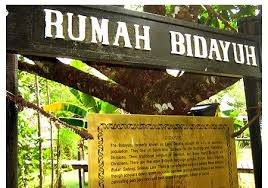
Origin of the Bidayuh
There are many different people living in Borneo today. Among these groups is a people with a similar language, the Bidayuh. They migrated south from Taiwan to western Borneo over a period of three thousand years. We are going to try to trace that migration.
The early expansion of people into Taiwan probably began 10,000 years ago from southern China. The Liangdao Man skeletal remains were discovered in December 2011 on the Min River, the shortest crossing from mainland China, dating to 8,060 to 8,320 BP.
The South Chinese then mixed with people from North China, who introduced rice cultivation. This formed the proto-Austonesian culture, which dates to 7-10K.
Later, proto-Austonesians migrated to Taiwan about 3,000 to 4,000 years ago. The Austronesian language probably developed from the language the migrants brought with them and the language of the local people who lived there. They then mixed.
This group then split into several different subgroups on the island of Taiwan and collectively became known as the Austronesians. In the northern part of Taiwan, they further split into other groups. For example, the Saisiat and Atayal (northernmost tribes) have the highest genetic diversity. Another northern group split in 5332 BP. This coincides with the Austronesian language development around 5230 BP. The next group split occurred on the island into central and southern groups around 4226 BP.
Eventually, there were many groups of people who lived on Taiwan. They first spoke a proto Austronesian and then broke up into 16 different dialects depending on where they lived on the island. All of the languages came from a common Austronesian group.
It is not known which of the 16 language groups on Taiwan the Bidayuh groups were associated with or which group they had migrated from. The Bidayuh language groups and the Taiwan language groups have just not yet been studied or compared to come to any definite conclusion.
Recent genetic evidence(Shan Ko,2026) has shown that the Austronesian peoples mixed with Austroasiatic people and others along their migration. These people were thought to have lived along the coastal Philippines and Borneo.
The earliest Austronesians, and hence the Bidayuh, migrated south into the Philippines and then into Borneo about 3,000 years ago. Why they left their homeland in Taiwan is not known. Most people believe they sailed down the coast of Sulu Sea, Sabah, Sarawak and settled in an area near a place called Sungkung on what is now the Malaysian-Indonesian border. Yet others say they came from Java to Sungkung because oral history from the shamans relate they came from Java. Either way, they seemed to end up near the western Borneo Coast.
There are several reasons why the Bidayuh settled West Borneo. The land provided a place for farming with limited mangrove swamps along the coast and the hilly up lands allowed for rice cultivation. The area can provide for a combination of seafood and forest animals. There were rivers where the Bidayuh could travel and migrate inland, avoiding the dense jungle forests.
Sungkung is now the home of the Biskuk Bidayuh group. The people speak a language close to that of other Bidayuh. Many of the oral histories of the Bidayuh state that they originated from there. It could have been the stopping and gathering point for the southern migration from the Philippines. The Bidayuh stopped at the Sungkung area settled and as the tropical soil wore out, moved inland.
Another theory thinks the Bidayuh migrated to Begau, and further migrations continued from there. Still another says Sungkung and Begau were just a place where an earlier Bidayuh group settled. However, other theories have developed from this contention that Sungkung arae is the center for the Bidayuh homeland and language. In any case the Bidayuh migration seems to have ended up in this area of Borneo. It could be the Bidayuh just ran out of the island, sailing south.
In order to tell the Bidayuh apart, we must look at their language. The main core or backbone was and is Austronesian from Taiwan. Then, they developed common language from the Austronesian we will call Bidayuh. From this language, we divide the Bidayuh language into four or six different groups. The number of Bidayuh language groups is unclear because linguists cannot agree.
The language groups come into existence for a variety of reasons. A group of people move away from the main group and form their own settlement. Over time, and within their own group, pronunciations and words for new objects are invented, and the language can morph into a new dialect. Being away from other groups also tends to reinforce these changes. This process, from an old language to a new one, can take a surprisingly short time, possibly 1,000 to 2,000 years. So, it is with the Bidayuh that people broke away from the main group and formed their own language. That main group could have been in the Sungkung area.
These four or six different groups became estranged from each other so that one group could not speak to another. Yet, when one analyses each language, the Austronesian Bidayuh core remains. Using this language criterion, we are able to tell which group possibly left the Sunkung area first.
If we agree that the Bidayuh to arrived on Borneo was at the Sungkung area, then the first group to leave and migrate outwards from there was thought to be Tringgus-Semban. Their particular language maintains the most Austronesian words. They moved inland from Sungkung and lived in the highlands. Possible arrival time from Taiwan 1500-1000 BCE.
The second group who left Sungkung were the Biatah,Padawan and Suburan settling along the Sarawak River. Their dialect shows conservative Austronesian language features but also innovations indicating periods of long isolation 1000-500 years ago. They probably settled in the area while migrating down the coast, or did they sail to Sunkung and then backtrack to the Sarawak river valley? Possible arrival time 1000-500 BCE.
The third group, the Bukar-Sadong, arrived from the Sungkung area and into Serian and probably came from a group of Bidayuh already living there. Their dialects are distinct, suggesting a later branching from a group already living there. 500-1000 CE
The fourth group were the Jagoi-Bratak. They are recent migrants from Mount Sungkung into Bau and Lundu about 700 years ago. They arrived much later because their language has a more cosmopolitan mixture of Malay words. 1300-1400 CE.
We cannot say one language group came from the other. The evidence points to separate independent migrations and thus separate language evolutions.
Another hypothesis is that a group of language related people arrived on Borneo, possibly at Sungkung. They already spoke a similar language before their arrival on the island. This group, over time, broke up into the four or six distinct sub groups we have today, all having one common language at the beginning. Nobody knows when the above ancestral population arrived on Borneo.
Bidayuh and Santubong
The trading port of Santubong was the home of many Bidayuh who worked with metal and agriculture during the period of sustained trade from the beginning of the first century. Boats would pull into Santubong for trade, freshwater, supplies and await for the monsoon winds to change.
Oral traditions suggest it was the Biatah who could trace their ancestors to Santubong. Another group associated with Santubong was the Jagoi-Bratak Bidayuh before their migration to Bau and Lundu.
The evidence shows there was a large metal working site at Santubong. We know the Bidayuh lived in the area. We are guessing these Bidayuh were the metal workers of Santubong. But, we don’t have any direct evidence like a spear point that has “Made by the Bidayuh” written on it.
There are so many unknowns in this history. When the Bidayuh left Taiwan and arrived in western Borneo, whether they had one common language and then split into many, or if they arrived in pulses with the dialects intact, are just a few. It will not be until swabs are taken from all four or more groups and the genetics studied that the debates and issues will be settled.
Tom McLaughlin for BorneoHistory.net
Bibliography:
Albert Min Shan-Ko Early Austronesians into and out of Taiwan Am J Hum Genet. 2014 Mar 6;94(3):426–436
Albert Min Shan-Kho Genetic Insights into the Origin, Admixture, and Migration of Early Austronesian People Journal of Human Genetics (2026) 71:63–72; https://doi.org/10.1038/s10038-025-01380-8
Bellwood, Peter The Austronesians Canberra: Australian National University Press, 1995
Chan, Pat Foh History of Serian Bidayuh in the Samarahan Division Kuching,:Sarawak Press, 2004
Ken Ichi Shinoda et al Ancient DNA Analysis of Palaeolithic Ryukyu from Piper, Philip ed. New Perspectives in Southeast Asia n and Pacific Prehistory ANU Press 2017
Kustanto, Johannes Baptis Hari (2002). The Politics of Ethnic Identity among the Sungkung of West Kalimantan, Indonesia. Yale University PhD dissertation
Minos, Peter The Future of the Dayak Bidayuhs in Malaysia Kuching:Lynch Media 2000
Smith, Alexander The Historical Phonology of Hliboi, A Bidayuh Language of Borneo Oceanic Linguistics, Vol. 60, No. 1 (JUNE 2021)
Smith, Alexander (2017). The Languages of Borneo: A Comprehensive Classification. University of Hawaiʻi PhD dissertation
Tom McLaughlin for BorneoHistory.net