
Pirates of Southwest Kalimatan
The sea people were foreign migrants who established their communities along the coast. Their ethnic background was varied and considerably mixed.
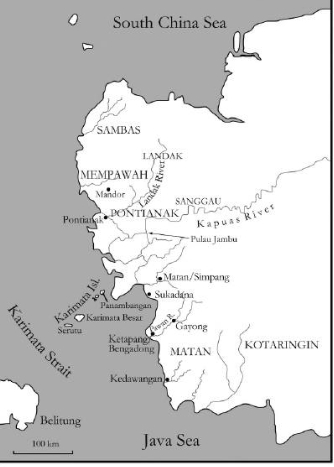
Among these was an important group called the Orang Laut, who settled in Kampong Palembang in Karimata Besar. Karimata Besar is an island in the Karimata chain located between Belitung Island and Borneo. The orang laut had migrated from Lingga under the leadership of Baden Galang. Baden means ‘sea noble’ and was a typical title for the leaders of the orang laut. They settled in a kampong that the Chinese had abandoned in 1808.
The Chinese are not mentioned as pirates in Southwest Kalimatan(Borneo). Seventy to eighty families engaged in fishing and blacksmithing in Kampong Palembang as well hunting turtles and foraging for their eggs. However, these Chinese were forcibly taken and transported elsewhere in 1808, possibly because of their blacksmithing skills.
Another important group came from the Sulu Sultanate in the South Philippines. One large group established themselves in Sukadana Bay under the pirate chief Datu Camerang, or aka Raja Sabrang, the brother of the Sultan of Sulu. Datu Camerang had replaced Gusti Bandar, who had fled earlier. Datu Camerang appointed a number of petty chiefs in neighboring areas to maintain his influence. Although most of his followers came from Sulu, there were many other strangers including Tuan Said from Arabia and Inisari of Orang Kayan origin.
Ketapang was established in 1816 by Nachoda Kadar of Matan. Under him were 140 Malays, 60 Bugis, 2 Arabs, 12 Chinese and 80 slaves. The Bugis only stayed in Ketapang for half a year because their families were elsewhere.
Bengadong was a typical pirate’s lair. Pirates, such as Nachoda Deika from Brunei and Nachoda Raga, a Bugis, kept slaves who worked the fields, cut wood and fished. The slaves also joined in pirate forays.
Kubu was also a pirate base. A relative(name unknown) of Sultan Abdul Rahman of Pontianak founded the town. By 1822, the township had grown with a population of 400-500 Malays, Arabs and other foreigners. The Sultan and his pirates, now called the Sherif of Kubu, attacked cargo ships departing from Pontianak and Mempawah.
In the Karimata Islands, a group of Malays, who were thrown out of Siak, because of a dispute with the Sultan, settled in 1765 and extracted tolls from passing ships.
In Simpang , a vassal state of Matan, emerged as a major trade center after many hundreds fled and established homes after the attack on Sukadana in 1786. By 1822 they were able to export iron, forest products such as wood and damar, as well as bird nests, turtle eggs and many of their products.
Ships from Simpang took their major trade products to Kubu, Pontianak, Riau, Palembang and Singapore. A group of Chinese created a village(kongsi) on a hill near the river to buy and sell cargo plundered by the pirates, including slaves. Some of the plundered items were used in the community.
The Sultanate of Matan was oriented towards maritime trade despite its inland location. The most sought after items were birds nests, eagle wood, rattan for binding, turtles and many medicinal roots and barks.
Gayong had been a small Dayak village until Sultan Endra Laya made it the capital of Matan. In 1822 its population consisted of 500 Malays, 40 Bugis, ten Arabs and people of Arab descent, 300 orang Bugits and Dayaks, all under royal family members or other elites. Before, fleets from Gayong went to Riau, Palembang and Terengganu, but later they sailed exclusively to Singapore. The people of Gayong were both traders and pirates.
Brunei pirates had the reputation of being the fiercest and their boats strongly manned. By the early 1820’s Datu Camerang migrated to Brunei. He lured a number of pirates to join him. He became one of the most influential chiefs, making use of his association with the Brunei Sultan. He drove other pirates away from northwest Borneo. Datu Camerang made an annual raiding foray along the west coast of Borneo.
The Sea People established ties with various types of local rulers. The leader of the pirates on Karimata Besar married one of his granddaughters to the son of the Sultan of Simpang. This meant the Sultan of Simpang was responsible for the pirates. Another of his grandaughters was married off to the pirate chief Uwan Smail of Kedewangan in Ketapang.
Plundering was an important skill of the sea people. When they departed from their base, they made a complicated agreement with the local ruler. In Bengadong the rulers provided food in exchange for booty. The rulers also maintained the pirates’ ships. Matan Sultans and other elites kept eight to nine large ships ready to sail. The Sultans, elites and pirates did not want to keep the plunder long, preferring to quickly offload it.
One does not think of fashion among the pirates in southwest Borneo, but styles did grace the people. Men in general preferred Bugis textiles for their clothes and trousers. “Important” men wore European chintz with large flowered patterns for men’s jackets (baadje),women’s jackets (kebaya) and bed cloths. They also used Chinese silk for decorative hangings, bed cloths and head cloths. One group used adopted a part Bugis part Arab type of dress using Chinese silk as a type of waistband. Women wore a one-piece sarong around their trunk and a large piece over their heads. These fashions fuelled a strong demand for cloth.
From:
Ota, A. (2010). Pirates or Entrepreneurs? The Migration and Trade of Sea People in Southwest Kalimantan, c. 1770–1820. Indonesia, 90, 67–95. Cornell University Press.
Tom McLaughlin for Borneo History.net