
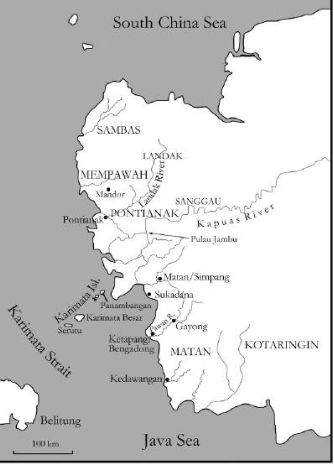
The History of Pontianak and Sukadana from ~1770-1820
We go to the east coast of Borneo Island and take a look at some of the history there.
Riau was connected to the India-Sino-Southeast Asian trade network, also called the Maritime Silk Road. Through various ports, this network connected India, China and Southeast Asia. They traded silk, porcelain, and tea from China, and cotton textiles, spices, and gems from India. From Southeast Asia came cloves, nutmeg, camphor and from Arabia and Africa came incense, ivory and gold. The island became a major trade centre in 1673.
The year is 1784. Riau was a huge trading center for the Johor Sultanate, located at the tip of the Malay Peninsula. Then the Dutch attacked because they wanted to dominate trade in the area. The trading centre of Riau fell to the Dutch, and its trade links also collapsed. Smaller ports, such as Terengganu on the northern peninsula and Siak on Sumatra, picked up some of the trade, but neither was able to match Riau.
The Bugis were people from the South west peninsula of Sulawesi one of the islands in Indonesia. They were rice cultivators but became famous as maritime traders throughout Southeast Asia. They migrated en masse throughout the Malay Peninsila, Borneo and other parts of the archipelago from 1667 to 1700. They converted to Islam for trade purposes in 1651.
Sukadana
The town of Sukadana was said to be established by a Prawi Jaya, who founded the town with the help of the local Dayak population. Prawi Jaya had himself enthroned as Raja or King. Sukadana gradually developed, and trade in gold and diamonds commenced. Sukadana was later moved inland to avoid pirate attacks and became part of the Sultanate of Matan. Around 1550,the people accepted Islam in order to facilitate the lucrative trade with the Arabs.
At the beginning of the 17th century, after repeated wars and alliances with neighboring kingdoms, Sukadana grew into a strong entity with Landak being a base for diamonds. Both the Dutch and the British visited the port to trade for the diamonds.
By the early 18th century, Sukadana strengthened its relationship with the Bugis at Riau and northeast Kalimantan. After a revolt in 1725, the then Sultan Din, fled to Kotaringin and asked the Sultan of Banjarmasin for help. Responding to this call, four Bugis princes assisted. They were later to become the leaders of the Bugis diasporas, which ruled throughout portions of Malaya and Kalimatan.
During the reign of the 11th and 12th rulers, 1736-? and ?-1790), Sukadana began receiving waves of migrants. Where they came from is unknown, but it is thought many people came from Riau. Various Malay chiefs also settled in Sukadana during this period, among them was Gusti Bandar from Riau.
Gusti Bandar, along with his Malay followers, opened new rice fields in 1768 and contributed to the development of the region. One of his daughters married the crown prince and, by 1779 they had temporary residences there.
Groups of Arabs also visited the area and engaged in trade with Sukadana and the places up the Kapuas River. They settled along the Mendau River and the Sultan encouraged other migrants to settle within the Bay of Sukadana.
During the 1760’s and 1770’s Sukadana received much trade because of the new arrivals. British, French and Portuguese traders called at the port but its unclear what they traded, except for the diamonds which came down the Kapuas River. The 12th Sultan had two rock dams built at the mouth of the Sukadana River to stop pirate invasions.
Pontianak
Meanwhile, the son of a settler who arrived in Sukadana in 1730 and founded the town of Pontianak. Born in 1742,the son, Abdul Rahman moved to Banjarmassin, where he organized a flotilla to pursue trade and piracy. After establishing Pontianak, he returned to Sukadana, where he found his father had died and he was not welcome by the locals. He moved back to Pontianak. The Bugis Raja Muda of Johore helped Abdul Rahman consolidate his power over the entire Kapuas River. Pontianak surpassed Sukadana by the early 1770’s. It became a transhipment centre for goods from the inland region in exchange for foreign goods and commodities.
It was the Bugis who dominated in the collection of inland products. These included diamonds, gold and iron. They also tried to corner the gold market by bidding up the price at Landak. Other products included yellow wax, bees wax,(natural wax from honeycombs), camphor, pepper, rice , pearls, birds nests and salt.
Chinese traders came every year in three to eight junks. They brought with them silk, porcelain, ironware and tobacco. They bartered for camphor and pepper and purchased gold and beeswax. Traders also came from Cambodia, Siam, Malacca, Terengganu and Makassar. Javanese brought white and colouedr yarn as well as cannons and flintlocks. Numerous local ships visited from Brunei, Sambas and Mempawah. In the three months from November 1778-January -1779 the Dutch observed 238 large and 500 small ships arriving and 117 large and 625 small boats departing.
The trade at Ponitanak dropped dramatically after 1779. A Dutch scholar, Van Goor, attributed the decline to the unwillingnesss or inability of the Sultan to pay for his products and the intervention of the Bugis in the gold trade.
However, conflicts with neighbours seem to be a better reason. Sultan Abdul Rahman of Pontianak seemed to be in a bitter battle with Landak. Abdul Rahman wanted the Sultan of Landak removed so he could take that position.
Aside from Landak, Pontianak was locked in strong rivalries with Sukadana and Mempawah. Mempawah began to receive more goods, including gold from upstream settlements. By 1781, most of the trade switched to Mempawah and, to a lesser extent, Sukadana from Pontianak. The anger felt by the people of Pontianak from the loss of trade resulted in an attack on Mempawah and Sukadanna along with Dutch support.
The Dutch attacked and defeated Riau in 1784. The Sultan was killed, and the Sultan’s son fled to Mempawah and then to Pontianak. Finally, the new Sultan and his entourage settled in Sukadana. After the arrival of the new Sultan, Sukadana again became a major trade center. This angered the Dutch and the Sultan of Pontianak.
In 1786, the Dutch army, coupled with Malay ships and 400 Bugis soldiers under the command of the Crown Prince of Pontianak, attacked Sukadana. The residents of Sukadana escaped to Matan. The Sultan fled up the Pawan river to the Dayak settlement of Gayong. Gayong became the capital, but the area was always called the Sultanate of Matan.
Sukadana became a “bandit lair” despite attempts by the Dutch to revive the port by appointing a Prince to the throne. Impoverished, the remaining citizens turned to piracy. It also became an excellent opium market for the British.
By 1810, the population of Pontianak consisted of 3,000 Malays, 1,000 Bugis, 10,000 Chinese and a large number of slaves and “others”. The Chinese were engaged in diverse occupations such as shopkeeping, farming, distilling arrack, producing sugar, searching for gold dust and trading into the interior and along the coast. The Arabs were devoted to trade, while the Bugis occupied themselves with making Bugis cloth and weaving silk into cloth. They traded with Penang, Java and Bali. They kept slaves at home to provide labour for gardens and other domestic activities.
In summary, the trade data from 1778-1821 showed the following: Pontianak was an exporter of diamonds and gold and an importer of Chinese and Javanese household items. Later, diamond exports dispersed to other neighboring ports while the gold exports passed into Chinese hands.
To be continued
With many thanks from Veronica Chang Schmidt
From:
Ota, A. (2010). Pirates or Entrepreneurs? The Migration and Trade of Sea People in Southwest Kalimantan, c. 1770–1820. Indonesia, 90, 67–95. Cornell University Press.
Tom McLaughlin for BorneoHistory.net