
This essay was originally published in 2001 but was just reprinted in a book in 2026 at the ridiculous price of $149. Dr Brandon Jones was the author and his ideas on animal migration back and forth between Sumatra, Borneo and other parts of Southeast Asia during the last two ice ages are the foundation of this topic.
Two major dry periods have shaped the distribution of primates in Southeast Asia. The first, known as MIS6, occurred between 191,000 and 130,000 years ago. The second, MIS2 (the Last Glacial Maximum), spanned from 26,500 to 19,000 years ago, with the coldest peak occurrring 22,000 years ago. However, primates at Niah caves indicate some reforestation by then.
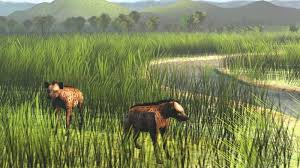
During both cold phases, temperatures dropped significantly and rainfall plummeted. Vast tropical rainforests gave way to savannahs and open habitats. The earlier and more severe event, MIS6, led to the complete elimination of primates from Sumatra. In contrast, MIS2 allowed primates to persist in the wetter northern regions of the island, with recolonization occurring between the glacial periods.
Throughout MIS6, the maritime climate of the Mentawai Islands—located off the coast of Sumatra in the Indian Ocean—provided a refuge where primates such as gibbons, leaf monkeys, and macaques could survive. These species later recolonized Borneo from these refuges.
Deforestation events coincided with the onset of both glaciations. Near Kuala Lumpur, pine grasslands replaced lowland tropical rainforests—a pattern also observed in eastern Indonesia. The intense dry conditions were interrupted by a warm, humid interglacial period from 126,000 to 81,000 years ago, during which rainforests briefly returned.
Ferns died back during MIS6, resurged between glaciations, declined again during MIS2, and have since recovered. MIS2 may have also caused the extinction of the giant pangolin (Manis palaeojavanica).
Leaf monkeys and gibbons that recolonized North Sumatra after MIS6 closely resemble those from northern Borneo, rather than those present during the interglacial period. This suggests that leaf monkeys and gibbons migrated to Borneo during the interglacial, while long-tailed macaques and silver leafed monkeys arrived in Sumatra only after MIS2 ended.
As rainforests regenerated, primate populations in Borneo diversified and evolved. This implies that gibbons and leaf monkeys were absent from Borneo until about 100,000 years ago, during the interglacial, while macaques, spangled leaf monkeys, and probably lorises and tarsiers arrived around 80,000 years ago, at the end of the interglacial.These primates arrived long after that.
Before this influx, Borneo was likely home only to orangutans and proboscis monkeys, suggesting substantial barriers between Borneo and western Southeast Asia.
These barriers were not unique to primates. Butterflies and extinct elephants (stegodonts) appear to have reached Sulawesi from Asia via the Philippines or Java, rather than Borneo. The absence of tigers, leopards, and wild dogs in Borneo, and proboscis monkeys and ground squirrels in Sumatra, challenges the idea of continuous land pathways between Borneo and Sumatra.
Other notable migration patterns include the black giant squirrel and wild boar, which reached the Natuna Islands from Malaya but never Borneo, just 160 km away. Malay Colobine monkeys made it to Great Natuna Island but not Borneo. The stink badger is found in Sumatra, Java, and Borneo, but not the Malay Peninsula. More than twice as many Indian mammals inhabit Malaya and Sumatra—and range into Java—as compared to Borneo.
These patterns do not indicate easy overland dispersal. Instead, most species likely arrived by rafting. The predominance of eastward primate dispersal suggests that prevailing westerly winds and currents assisted this process. Much of this rafting likely started from rivers along the east Sumatran coast.
The distance from Sumatra to Borneo may have favored dispersal to Java, but this alone cannot explain the difficulties faced by potential Bornean colonizers. The dry, cool climate and exposure of the desiccated Sunda Shelf were probably also major obstacles.
This dry zone also helps explain the absence of many animals on centrally located islands such as Bangka and Belitung. Bird distributions suggest grasslands persisted in southern Borneo long after forests returned to other parts of Southeast Asia. The fish fauna in northern Java likely recovered from populations in western Java, which was less affected by drought.
During the last ice age, animals survived in refuges on Borneo, such as Mount Kinabalu in the north, with the refuge likely extending discontinuously to Mount Dulit in Sarawak. Fossil evidence shows that two mammals now restricted to this area—the extinct lesser gymnure (Hylomys) and the ferret badger (Melogale)—once inhabited the Bornean lowlands during the interglacial.
The barriers to Bornean colonization only gradually diminished as the climate moderated. By the time rainfall had increased enough for rainforests to return to southern Borneo, potential colonizers still had to cross the sea. Plant and animals rafting from Sumatra would have had to bypass scrublands in southern Sumatra, only to encounter similar grasslands in southern Borneo.
Source:
Brandon-Jones, Douglas. “Borneo as a Biogeographic Barrier to Asian-Australian Migration.” In Metcalfe, Ian et al., Faunal and Floral Migration and Evolution in SE Asia and Australasia. Lisse: A.A. Balkema Publishers,2001, reprint 2026.
Compiled by Tom McLaughlin for BorneoHistory.net